Auschwitz

I told a friend this morning, “Just sit down for 10 minutes to write — something is always better than nothing,” so I should probably take my own advice and get to writing, huh?

Auschwitz day. After the previous day spent in the Jewish Ghetto and at Schindler’s factory, I was really not looking forward to going. But how could I be so close to such an important piece of history and not see it for myself? So off we went, leaving the youngest two behind for a fun day with Nana and Poppa. In hindsight, they both could have gone and Caleb would have been fine and most of it would have gone over Camille’s head, but I was glad for the time to focus on it with the older two boys and I know the youngers had more fun with the grandparents. Win.Win.
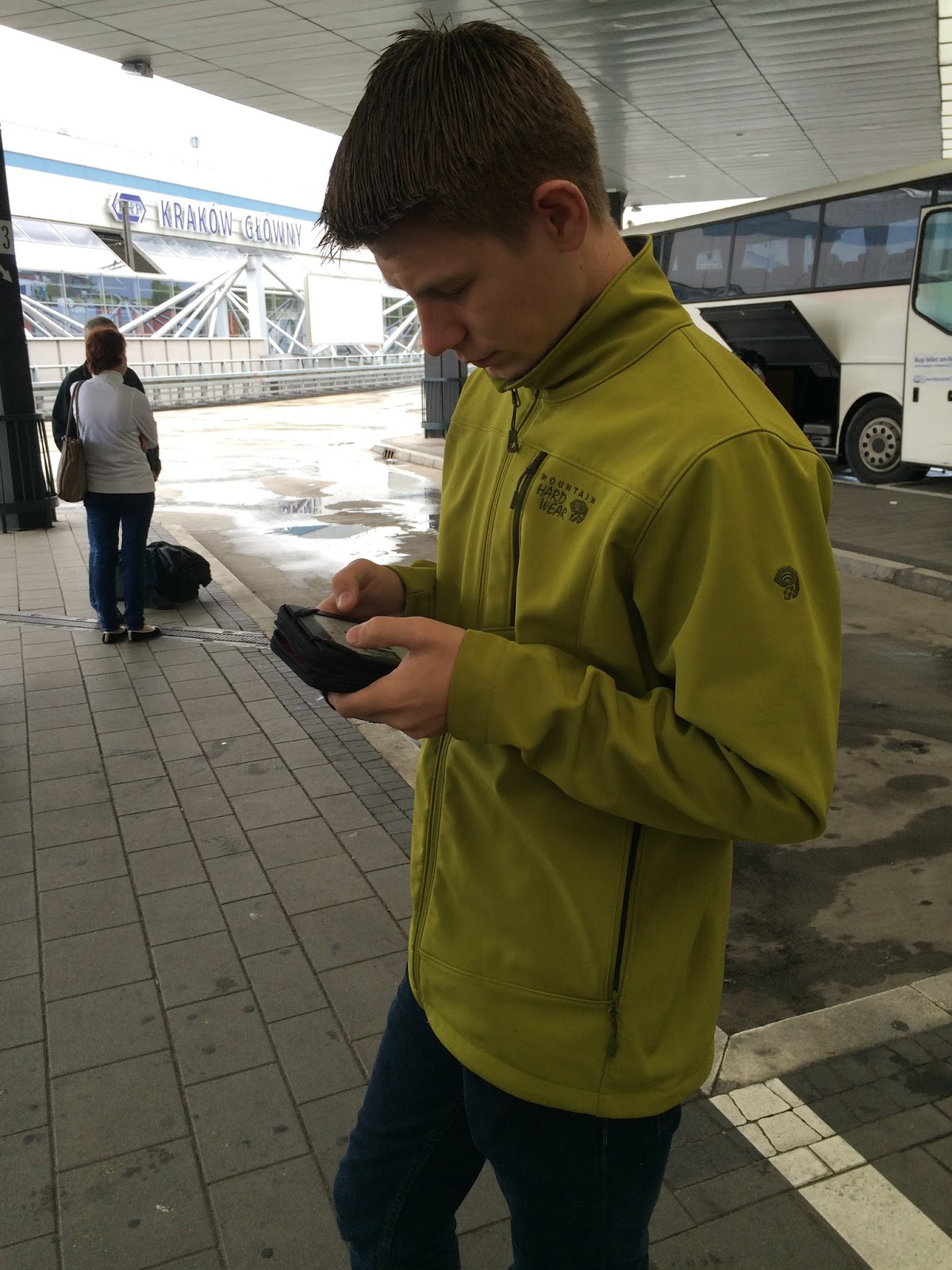
At the bus station. Public transportation in Poland is modern, easy, timed to the minute and the long haul busses all had faster wifi than what we have at home in Bahrain. While we were waiting for our bus, the boys would log in to whichever wifi was available and then as that bus left the station, pick up a new signal from a different vehicle. 
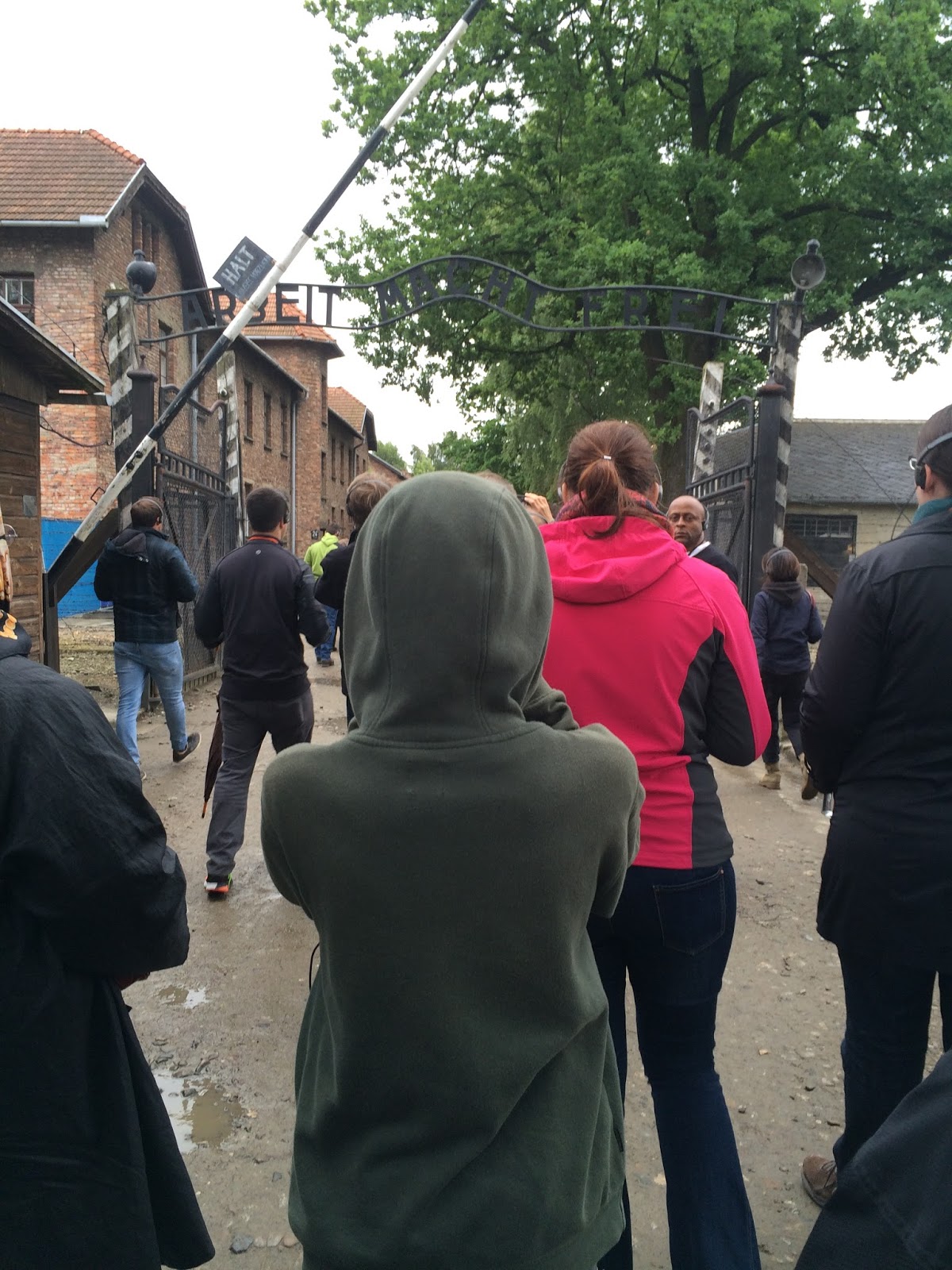
We arrived and joined up with an English language tour group. It was nice that we all had headsets and could hear our guide, Peter, no matter where we were standing. It’s great for someone like me who likes to be on my own program and not be standing right up front. 
Walking under the famous, “Work Makes You Free” sign. In one of the books we read, the girl, upon arrival here, mused that maybe her mother was right, and they would be able to work a certain amount before being freed. Nope. It’s an ugly lie. 

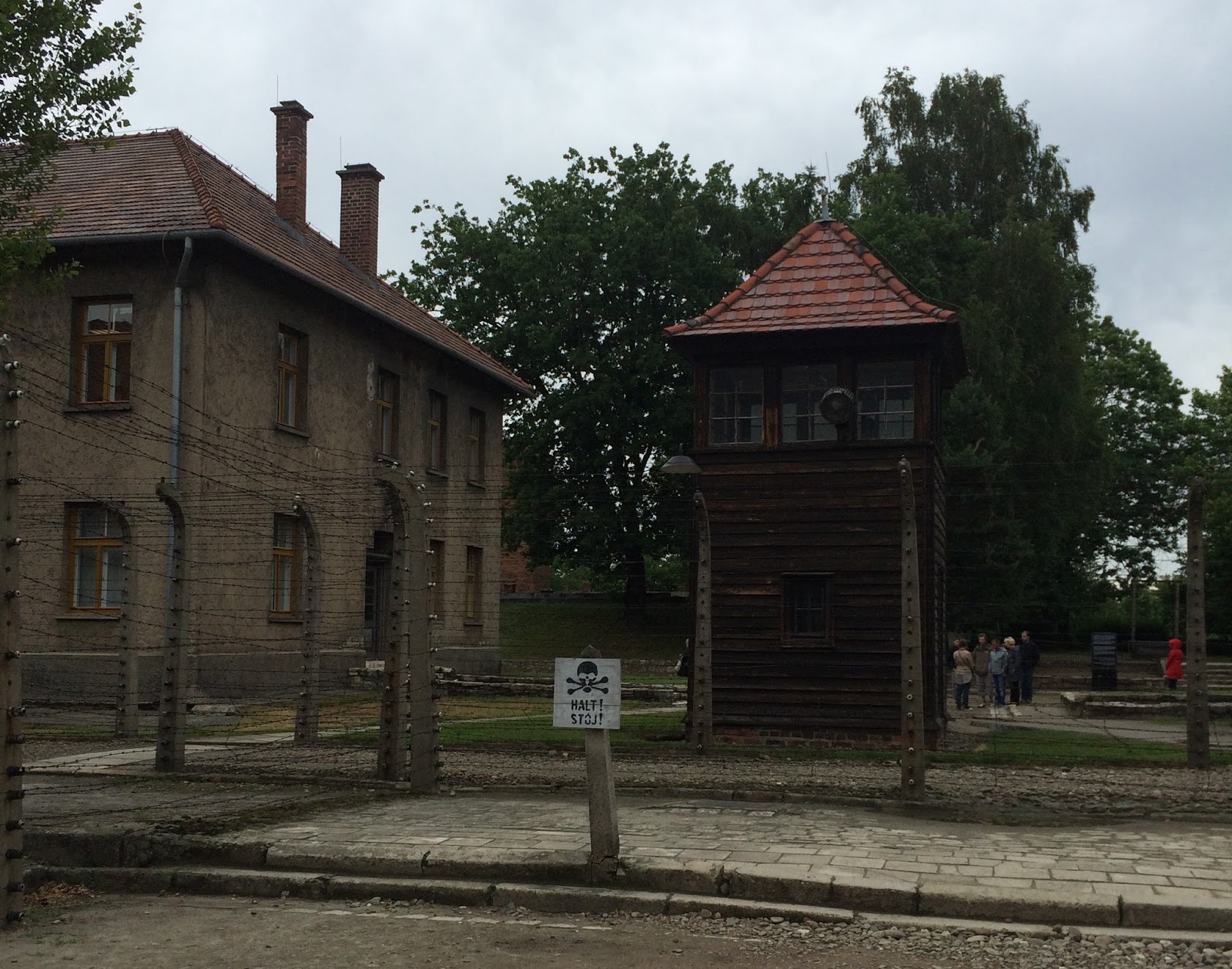
This place was originally a camp for political prisoners and was only later turned into a concentration camp. It reminded us of the military base at Ft. Sill, Oklahoma with its neat brick buildings and scattered trees lining the walkways. The exterior looks much nicer and more civilized than you’d imagine. 

Our tour took us inside several of the buildings. Some contained personal items that had been collected from incoming prisoners, pots (a roomful), clothing, eyeglasses and shoes, to name a few categories. I tried to imagine the people who arrived in particular shoes: The woman with the red heels, where did they tell her she was going? I felt an affinity for the woman who arrived in slippers, comfort first, right? Platform wedges — whoever she was, she was determined to look good, wherever she went. 

One of the photographs depicting arrival at Auschwitz II/Birkenau camp: Men on one side, women on the other, before they go through selection. The strong ones were picked to work, but the rest were told they were going to get a shower and be able to change, but were gassed instead. 
Our guide was very calm, respectful and somber. I appreciated that none of it was sensationalized or dramatized. Not much of the information was new to any of us, but connecting the stories with the actual places was invaluable. 

I didn’t take many photos. I wanted to observe and absorb and let the important parts sink in without feeling like a voyeur with a camera. One of the most emotional parts for me was one of the hallways where they had small mugshot style photos of prisoners with shaved heads that were taken as part of inprocessing. The photos covered the walls on both sides of the long hallways with the prisoner’s name, age, occupation and date of death beneath their picture. Every single one had the same wide-eyed and scared look in their eyes. These young, strong men who didn’t know what was going to happen next. Almost all of this particular group were brought to Auschwitz in 1941 and most of them didn’t last a year. 
They stopped taking photos of prisoners because the purpose was to use them for identification but they found that after several months, all of the prisoners became unrecognizable, so the photos were useless. 
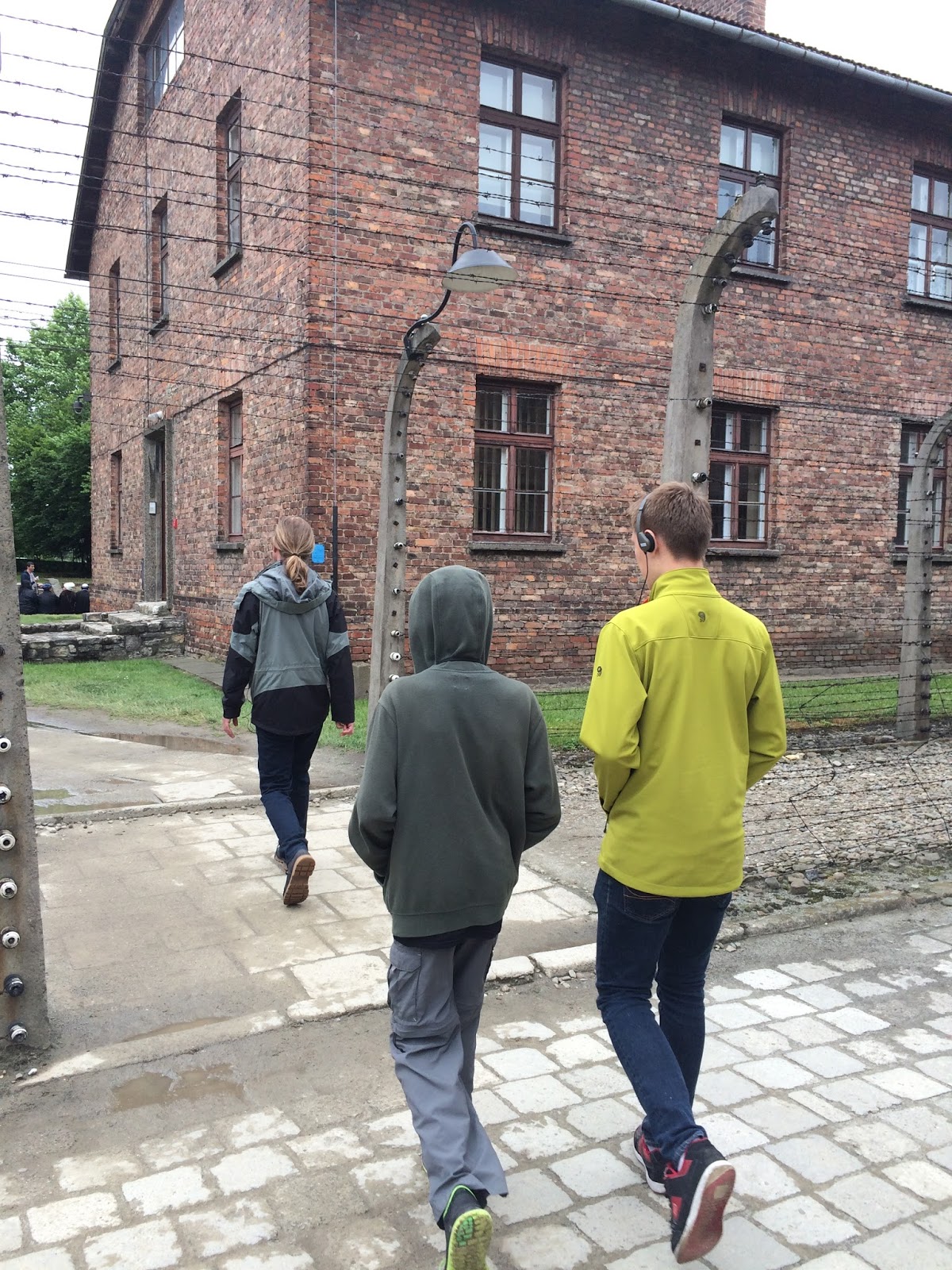
Leaving the inside of Auschwitz I 
After this portion of the tour, we got on a bus and headed about 5 minutes down the road to Auschwitz II/Birkenau. This is the huge extermination camp that makes Auschwitz “famous.” (and what you see if you watch Schindler’s List.) 

The train would pull right in through the archway and prisoners would be unloaded right next to the tracks. 
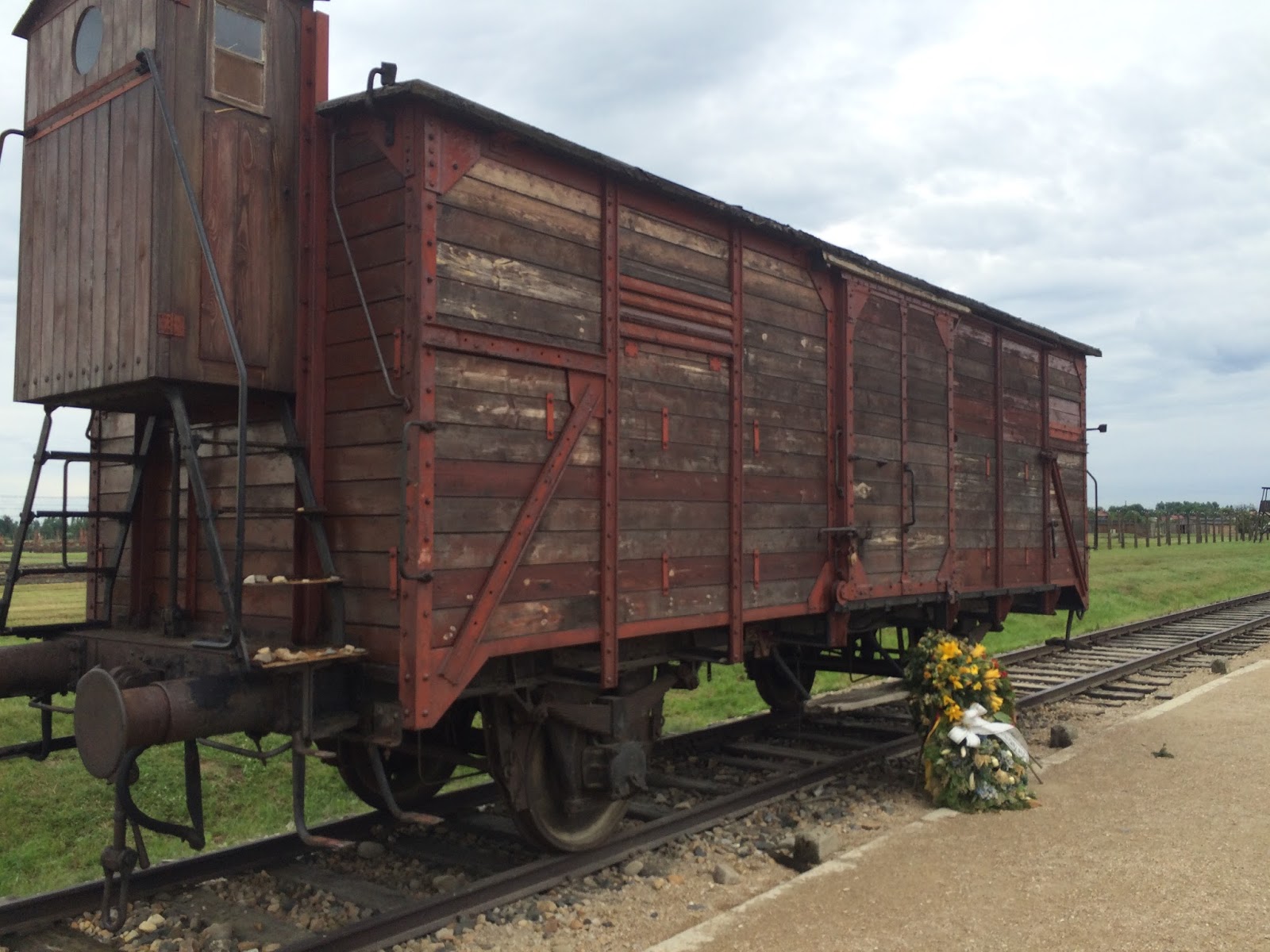
These are the kinds of rail cars they would arrive in. Typically they would hold 70 people, but the book we read described a time when they were desperate to fit more on and the solders were demanding 100 per car and then up to 130 per car. They couldn’t move to even wipe sweat out of their eyes because they were so tightly packed. 

This place was huge. Expansive. And there were plans in the works to expand it even further beyond that line of trees. 

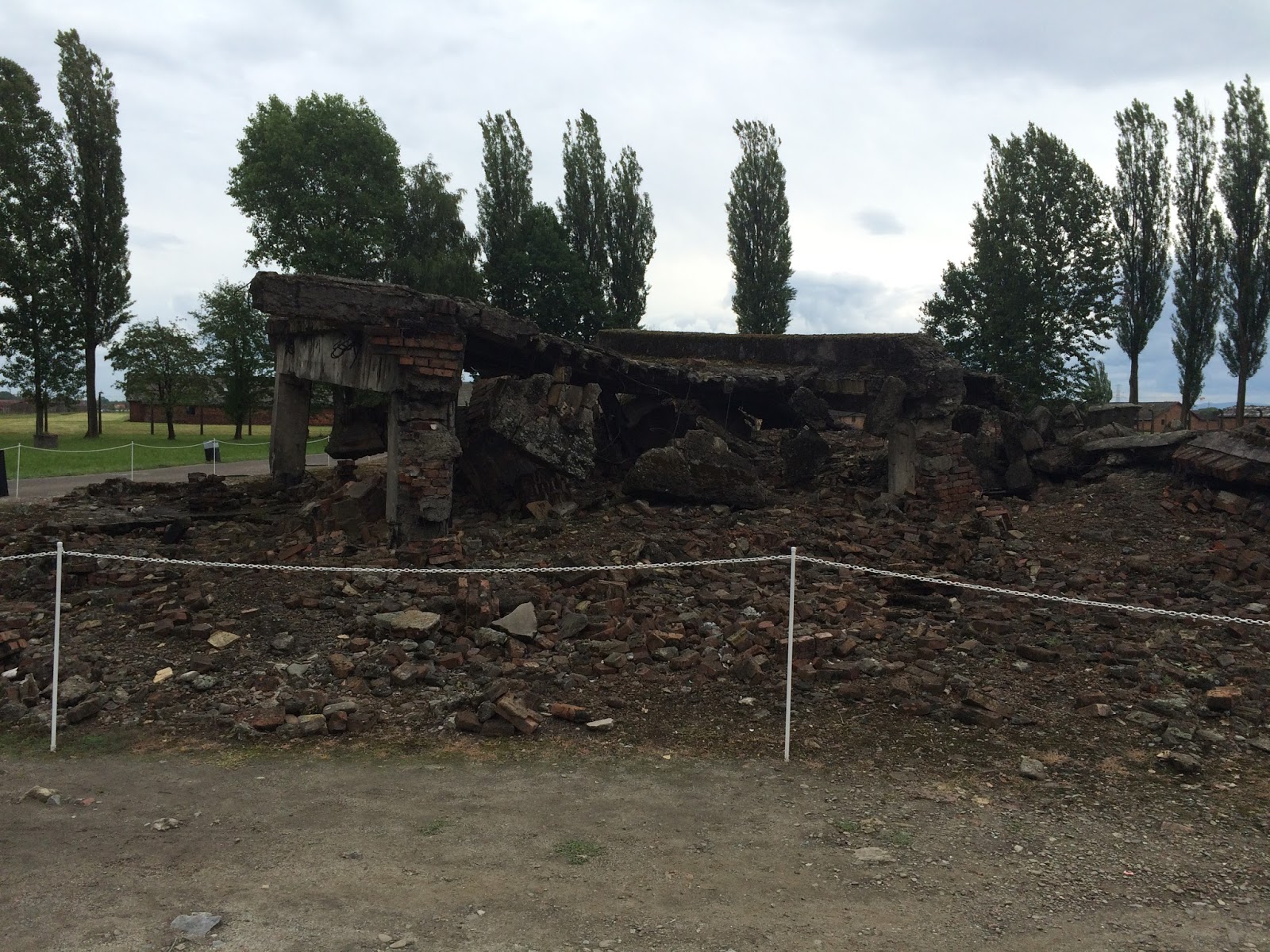
As the allied troops moved in, the Germans attempted to destroy the crematoriums. This is what remains. 
Each chimney is from one of the buildings that used to house prisoners. When the displaced German farmers returned to the area, they needed the wooden planks to rebuild their homes. A few of the buildings have been restored, but the brick chimneys mark the rest. 
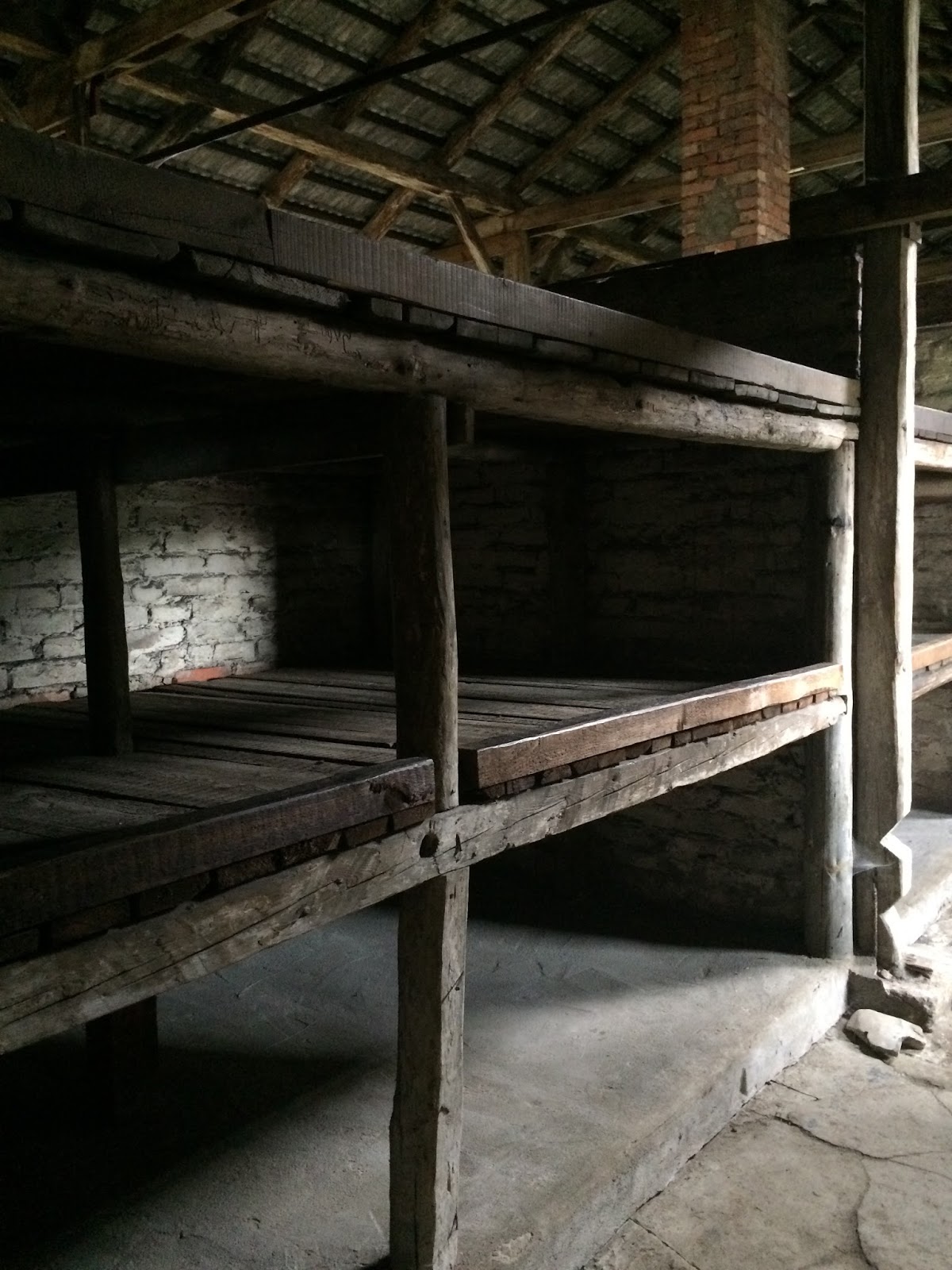
Inside the buildings where prisoners were housed. Hundreds of people were expected to sleep in each building. Our guide said that the floor was the worst for rats and if it was wet, but sometimes it saved lives when the temperatures dropped and those on the top levels froze.
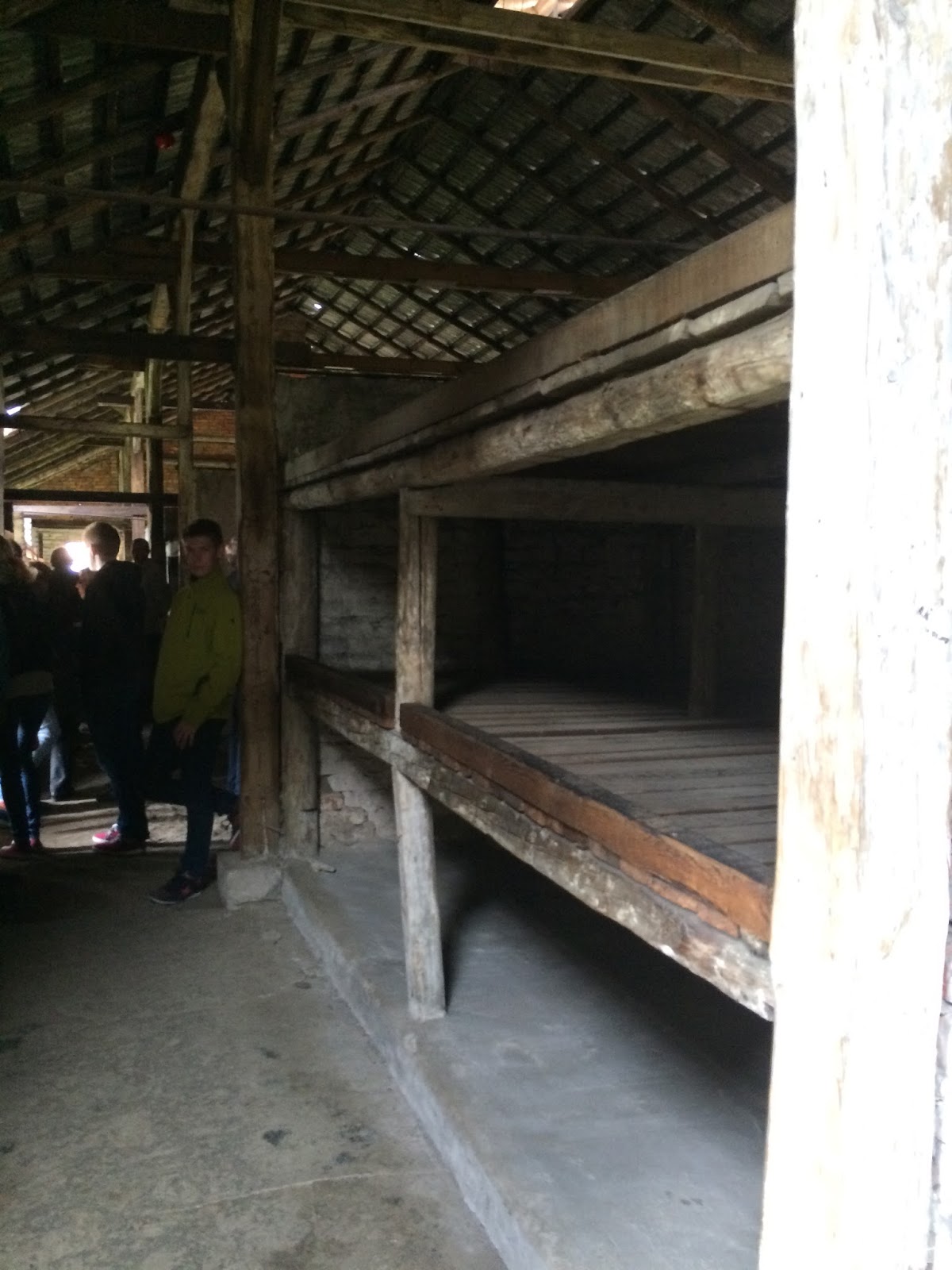
Thoroughly unbelievable that people had to live like this and that anyone survived. 

On a cool June day we were all wearing jackets. Imagining that those who were brought here had nothing but thin cotton clothes and had to endure exposure to all 4 seasons. 
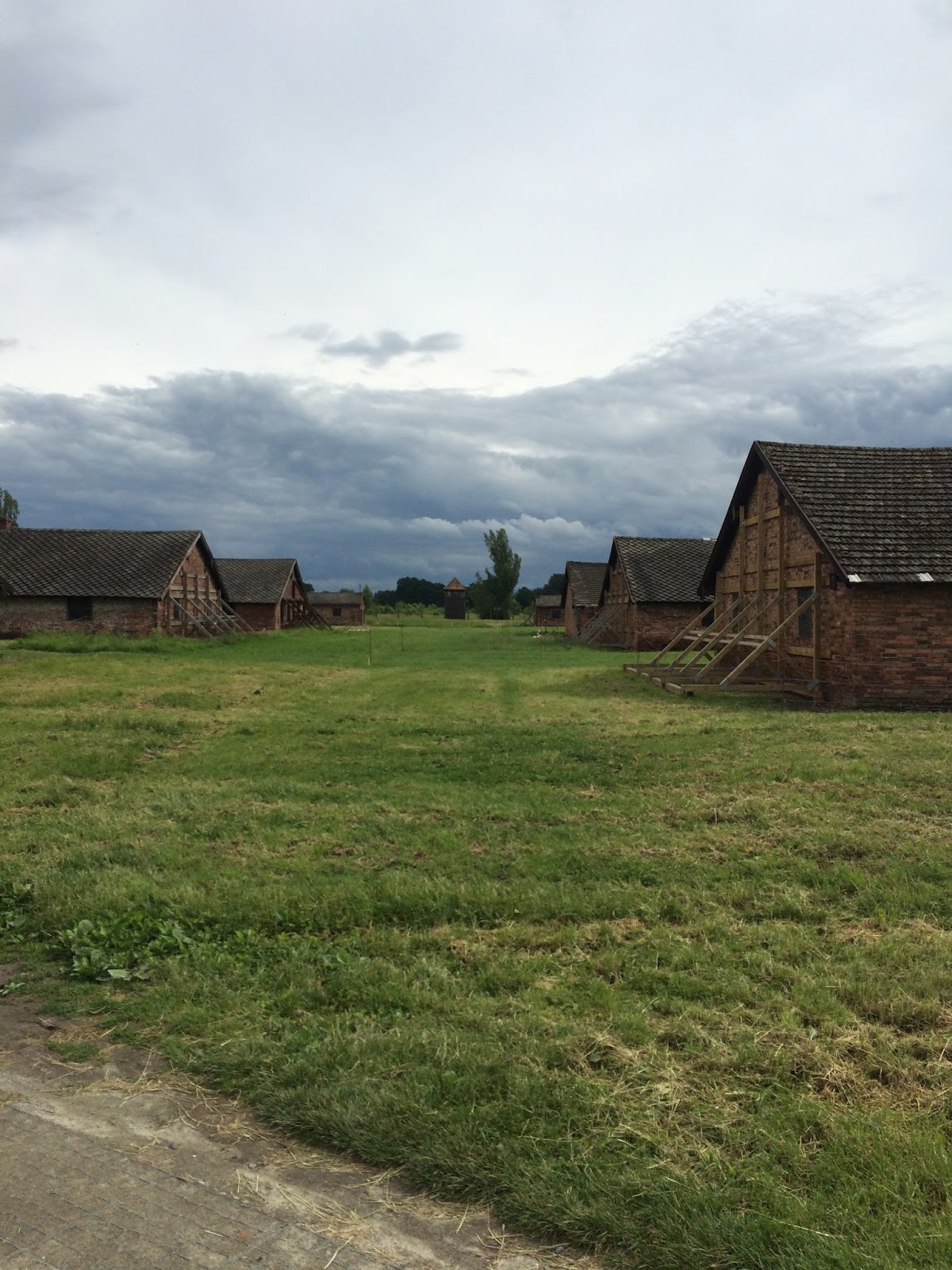
Auschwitz II/Birkenau was peaceful, meditative and quiet. Our guide told us a few things, but mostly we walked and observed. 
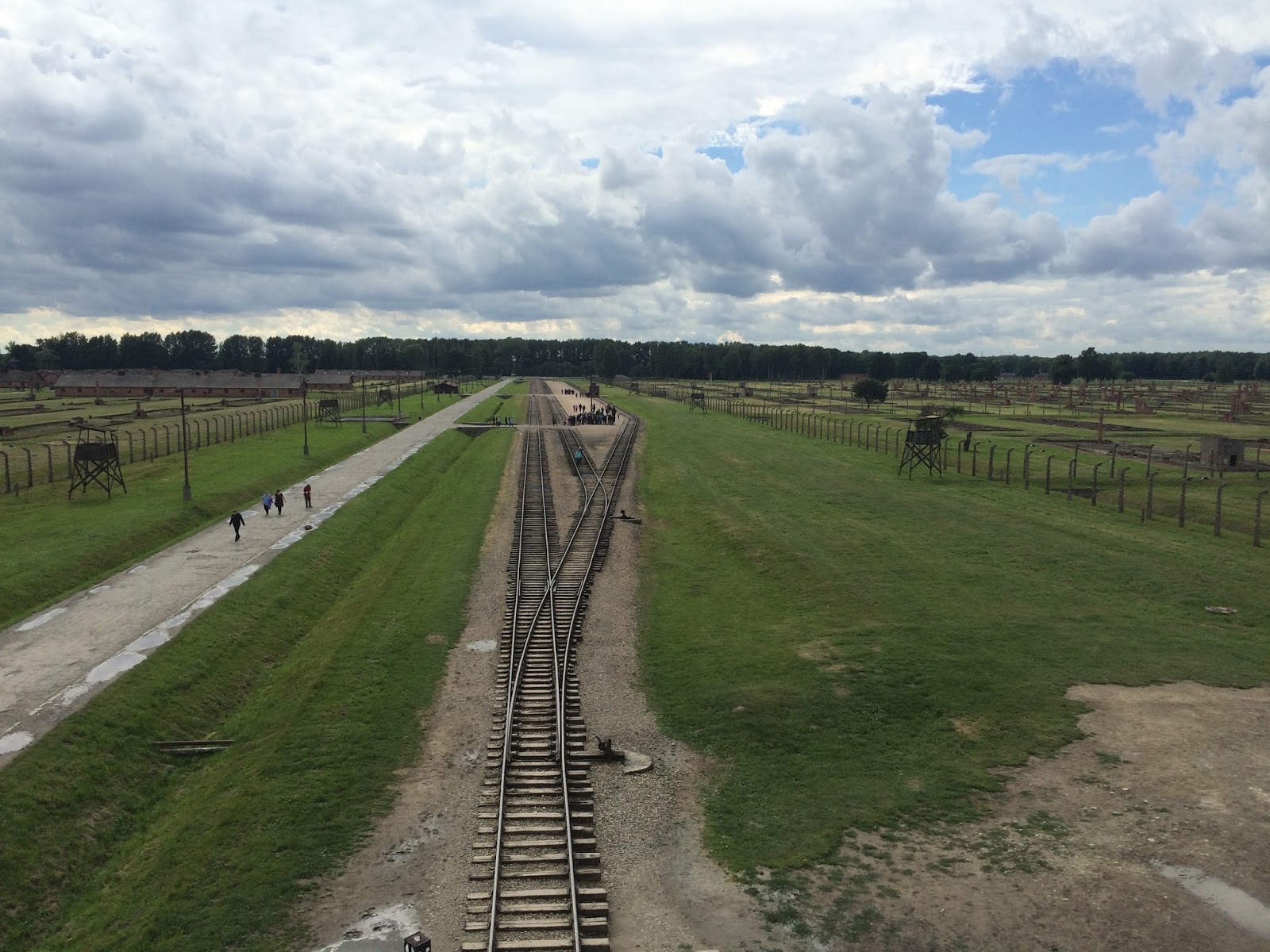
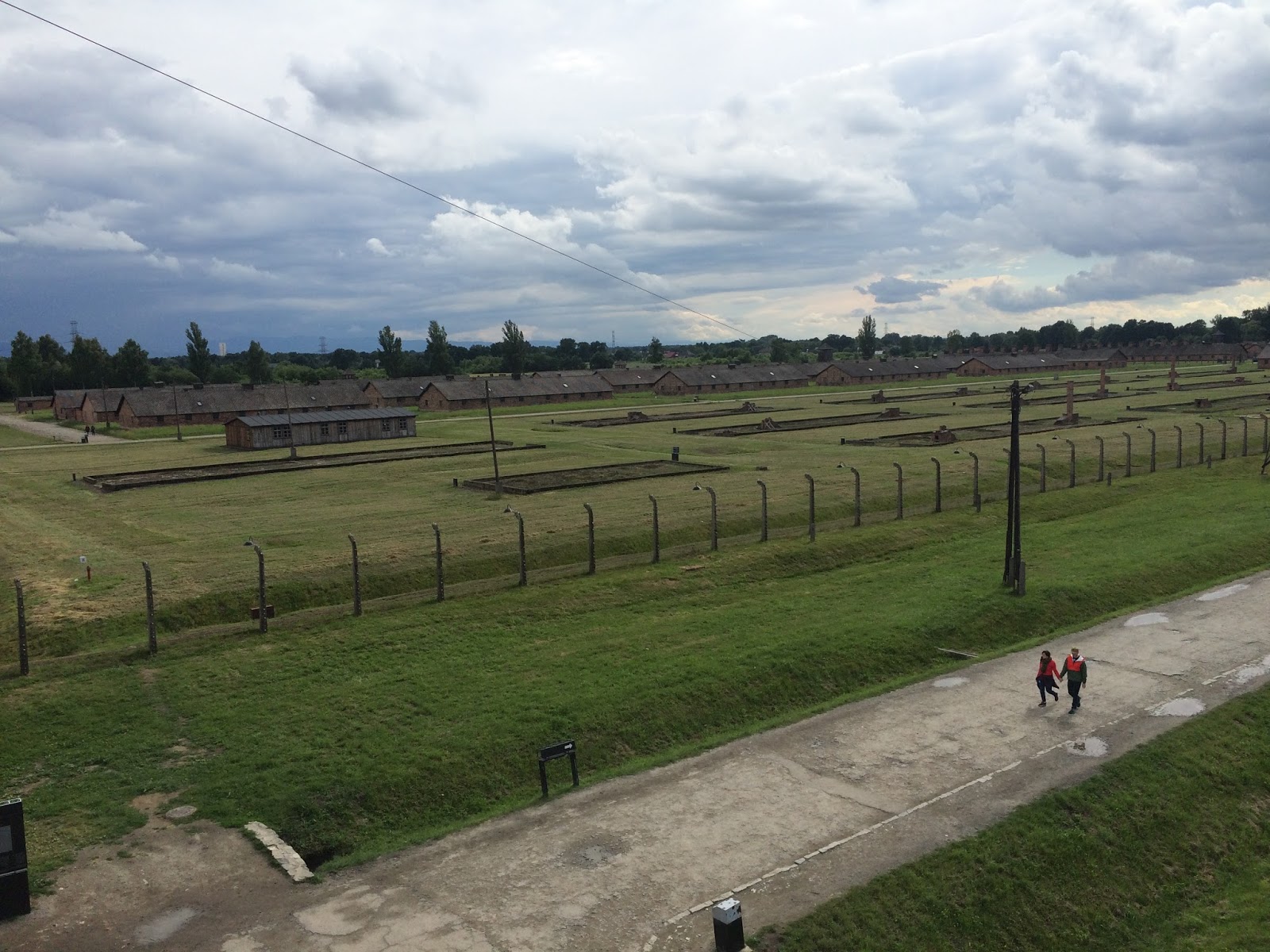
Views from the guard tower. Men were on one side of the tracks, women on the other. Crematoriums are hidden in the tree line. How did the guards live with themselves? What lies did they believe about why these people were here?
As we were leaving, we met this woman, a survivor of Auschwitz. She is a feisty, funny, and sharp 81 year old woman who has written a book about her time in the concentration camp. She and her twin sister survived because they were one of the sets of twins that Dr. Mengele experimented on. Her parents and two older sisters were sent to the gas chambers.

We bought her book and she signed it for us. Carter read the entire 90 minute bus ride home. A perfect end to a once in a lifetime experience. 

Outreach and body parts

I have a blog post about Auschwitz waiting in the wings. Truthfully I don’t have a post, just some photos, but I don’t have the words to do them justice. So it sits there, waiting for me to come up with something brilliant. In turn, I look at the page, don’t know where to start, and start another episode of Community (the Community as Law and Order episode has my utmost admiration).

I was thinking about outreach this morning after someone asked me about outreach opportunities here in Bahrain and I was feeling a bit “self-condemning” because I don’t really do any outreach, especially with local people. I’m not really a people person and I’m terrible with accents because of my hearing issues. It doesn’t particularly affect my normal life, but is magnified in groups or when there is background noise or when I’m trying to watch TV shows where they have British accents (I’m only getting about 80% of Call the Midwife and it’s killing me that it’s not subtitled). I greet my pool guy and car washer with a cold drink, a snack, and a smile every day, but that’s about as far as I’m reaching. 

Recently our pastor at church preached on 1 Corinthians 12 all about spiritual gifts and how all the parts of the body are necessary for it to thrive so maybe I’m that part of the body that knits and marathons TV shows so everyone else can do the important stuff. Is that a thing? Can I make it a thing? Just kidding. But along those lines, I think the way I’m serving now is to create space for other people to serve. This summer Josh has been leading worship at church and Calvin has been playing with the worship team. That takes several hours each week with planning/practicing and execution that I give up with them. And I didn’t complain when I had to get up at the crack of 8 am on Friday since our 2nd car is broken and we all had to go to church early because that’s when the worship team gets there. And Josh has been leading worship at our Bible Study group on Wednesday nights. And he’s been facilitating the Bible Study. So yeah, Josh is doing a bunch and I’m just getting out of his way.

Then I started thinking about his service in terms of outreach. He doesn’t have a ministry to non-Christians in a missionary sense like you would think of living in a foreign country. He’s not out there speaking about Jesus in Arabic to people in our neighborhood. Our circle of friends is very western, mostly because he spends the majority of his time at work with military people and the rest at church with non-American “westerners,” Brits, Aussies, South Africans, Scots, etc. But what he is doing is providing a way for these people to recharge and renew as they worship God each Friday morning, preparing them to go out to their workplaces where they are reaching people from other cultures. All parts of the same body, with the same ultimate goal, working together to make it happen.

I don’t need anyone telling me that I’m doing plenty (thanks Mom!) because I feel good about how I’m serving, especially when it’s quantified using the ripple effect. When I coordinate Kid’s Church, it creates an opportunity for people to serve God using their gifts of leading and teaching, it provides an undistracted environment for the pastor and congregation to hear God’s word, and hopefully as people grow in knowledge and experience of God, they are able to reach those around them. All the credit goes to one account.

I don’t spend a lot of time second guessing what I do, but it seems like every summer as our world shrinks while we hide from the heat, I wonder if I should be out there more, doing more, stretching myself more. In a few weeks school will start back up and I’ll be busier than ever before (cause kids in school are more work than kids out of school) and I’ll have too many things on my list to ever wonder if I’m doing “enough.” But right now it’s a good reminder that I am an integral part of the body, even if I do have time to binge-watch Extreme Cheapskates.

Birthday princess

After a solemn day, we celebrated Camille properly with a fun evening. All day she had been wearing her princess crown from Nana. It didn’t quite fit the theme of persecuted people groups and death camps, but you’re only 5 once!

We walked back up the main shopping road to the square where Caleb talked me into buying him a bird whistle that he had been longing for all week. I thought he was going to need to learn a special technique to make the sound, but all they do is add water to the bowl and then it sounds like a very loud, shrill, warbling bird. Awesome. 

So they showered their fellow man with terrible whistles while we watched the other street performers: man playing music on crystal glasses, a Giant skellator statue (he must have a box under his long robe to give him the extra height) who would time his movements to scare people walking by (that one was hilarious), a street-dancing troupe who was not up to the So You Think You Can Dance caliber, and various individuals or groups playing musical instruments. 

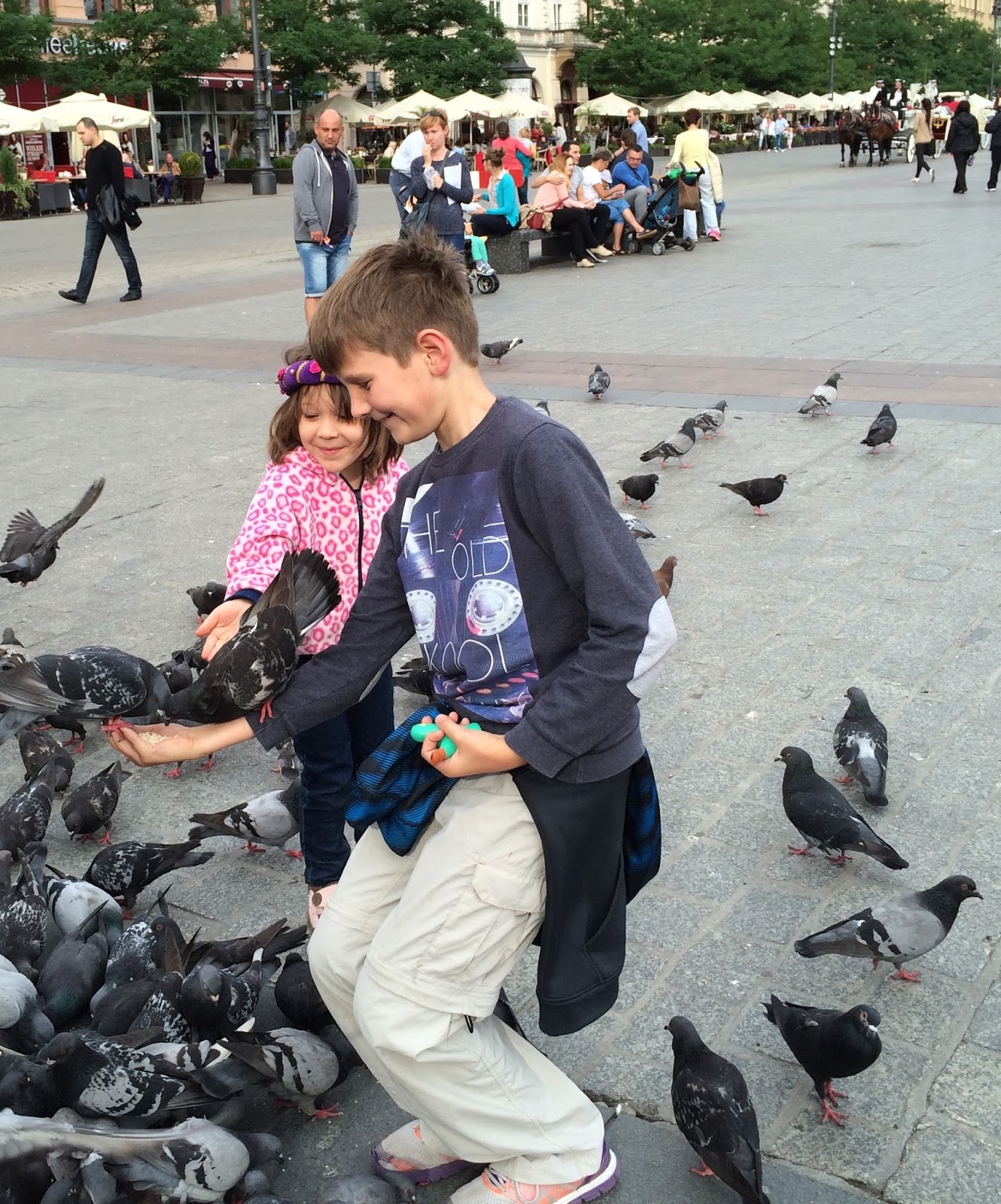
We saw a woman surrounded by a flock of pigeons and realized she had brought a bag of food for them. Caleb had spent the last few days trying to catch a pigeon so he went to see if he could get his hands on one while it was busy eating. The birds stayed just out of his reach until the lady gave him a handful of food and then they were all over him. Perched in his hand, on his arms, and one landed on Camille’s head and she ducked and ran away screaming. 
The bird whisperers
Who would have thought it would be so much fun to feed a flock of feathered rats? Sadly, I think this was the activity that the kids enjoyed most, since from then on it was “when can we go feed the birds again?!” I’m so glad that we went all the way to Poland for that. Kind of like the time we took 2 year old Calvin to Sea World and he was most excited about the ducks in one of the landscaping ponds. Woo. Hoo. 
Although, in their defense, we don’t really have flocks of pigeons in Bahrain. At least I can’t remember seeing them. And not “friendly” ones like these. Maybe a solo bird here or there. I vaguely remember seeing a few crows. We have a lot of cats. And sand. That’s about it. If I get excited about grass and rain, I guess it makes sense for them to think pigeons are a novelty too. 

When the birds had eaten their fill we headed back to the house to meet up with Nana and Poppa and get dinner. We returned to the restaurant from a few nights before with the amazing mulled wine. We wanted to try their specialty platter — basically a kitchen sink of polish food. Pickles, sausage, pierogi, fried cabbage, sauerkraut, and more. It was divine. 
It’s not actually a curved dish, just the panoramic lens makes it look that way. Our dinner was too long to fit in a single shot!
From the right: kielbasa on top of fried cabbage, pickles, chicken kabob and pork, boiled potatoes, and the black lentil looking stuff was this mushroom I-don’t-even-know-what, but I wanted to eat all of it. Maybe mushroom and bulgar wheat? That doesn’t sound appealing, but it was a grainy textured, earthy comfort food. Good thing I’m not a food writer or no one would want to eat at the restaurants I reviewed. 
Second half of platter from the right: the mushroom fabulousness, more boiled potatoes, the brownish thing at the top is a pork knuckle — pork cooked on the bone until it is falling apart, more pickles, 2 or 3 kinds of pierogi, and at the far end is another sausage on top of my other favorite thing, biggos. Also called Hunter’s Stew, it’s cabbage cooked with different cuts of pork (bacon, sausage, etc) and tomato sauce and again, that sounds boring, but it’s so good I ordered it at several different restaurants. It’s on every menu. 
Writing about it makes me hungry for Polish food — I never thought I’d be saying those words!
All week Camille had been begging to ride in one of the horse drawn carriages that are parked on the square so we told her we would do it for her birthday. 
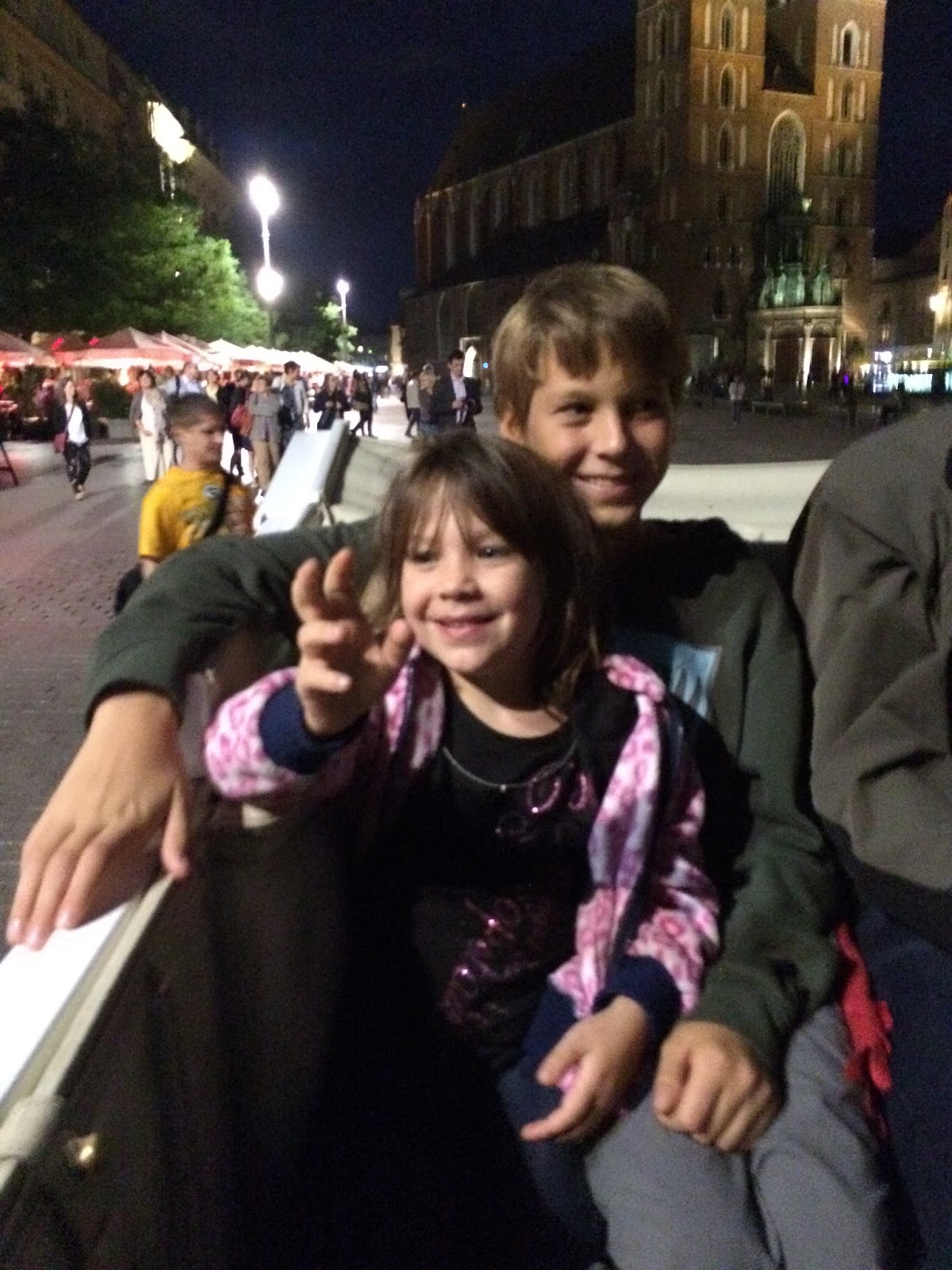
We climbed aboard and set off around the square, down past the castle and back. It was a 20 – 25 minute ride for 8 people for $35. Another Polish bargain. Nana and Poppa taught Camille to “wave like a princess” and told people, “It’s her birthday!” as we rode past. 

driving by Wawel Castle
Party in the carriage!
Calvin sat up front with the driver so the 7 of us could squeeze in the back. Good move, kid.
Petting her horses at the end of our ride.
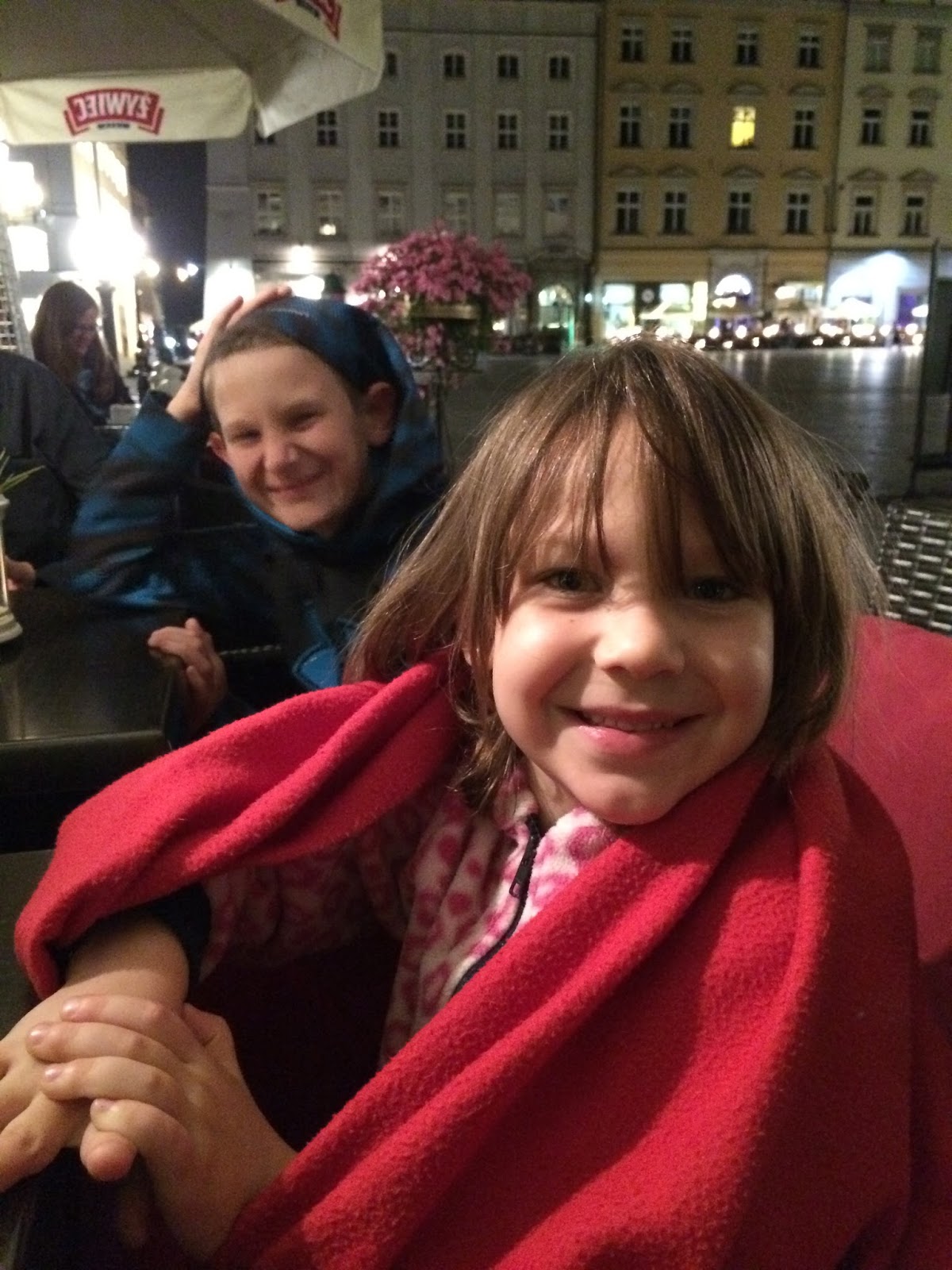
To end the evening we went to birthday dessert. It was about 10:30 by then but all was still lively on the square. We found outdoor seating at Noworolski’s, famous for being a favorite hangout of Lenin’s (it’s been open since 1910). 
Just as we were seated a light rain began to fall so we scootched our seats in closer to the center of the umbrellas, ordered up a bunch of desserts and enjoyed the pitter patter of the drops overhead as we tried a bite of everything. 
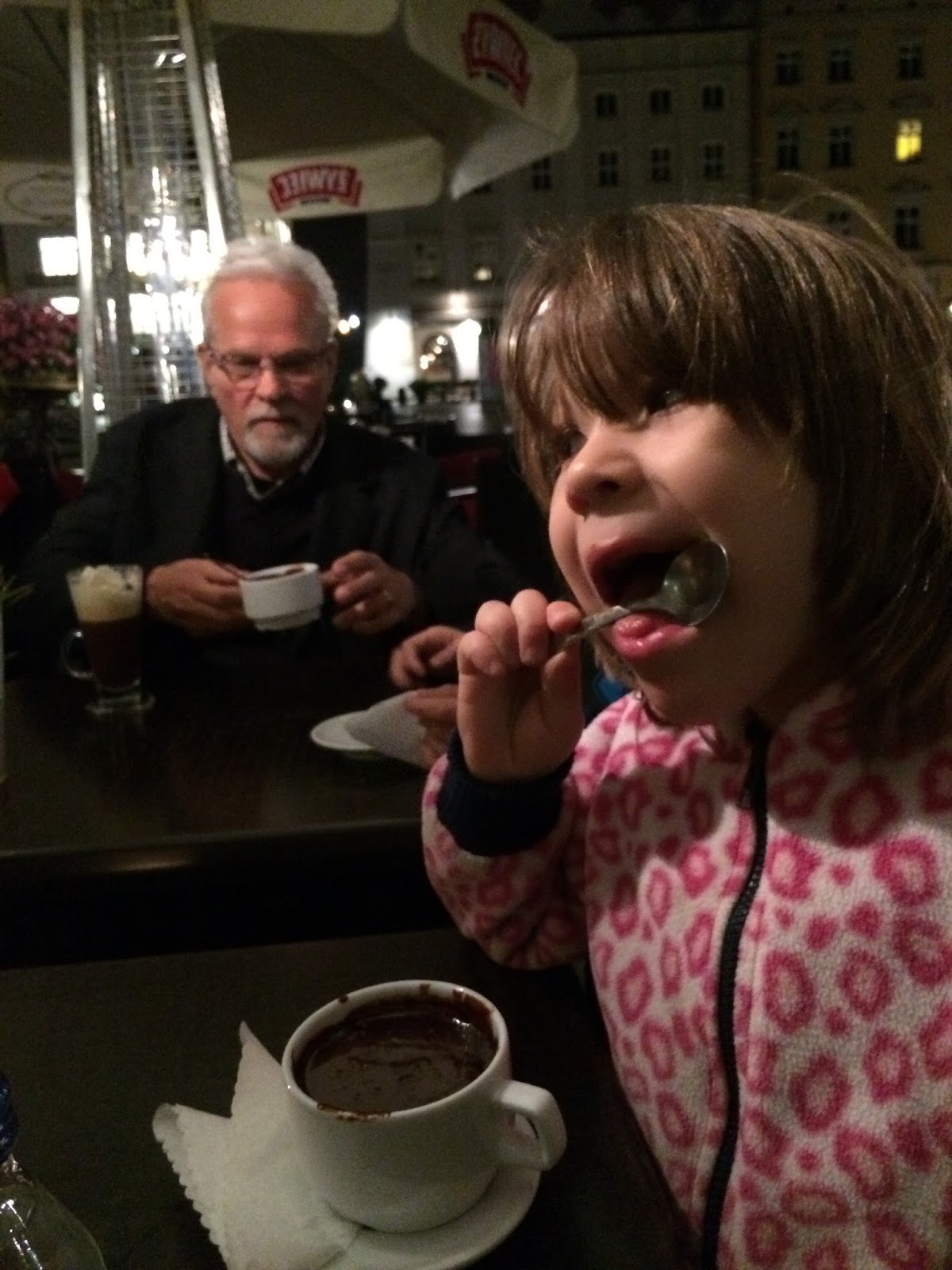
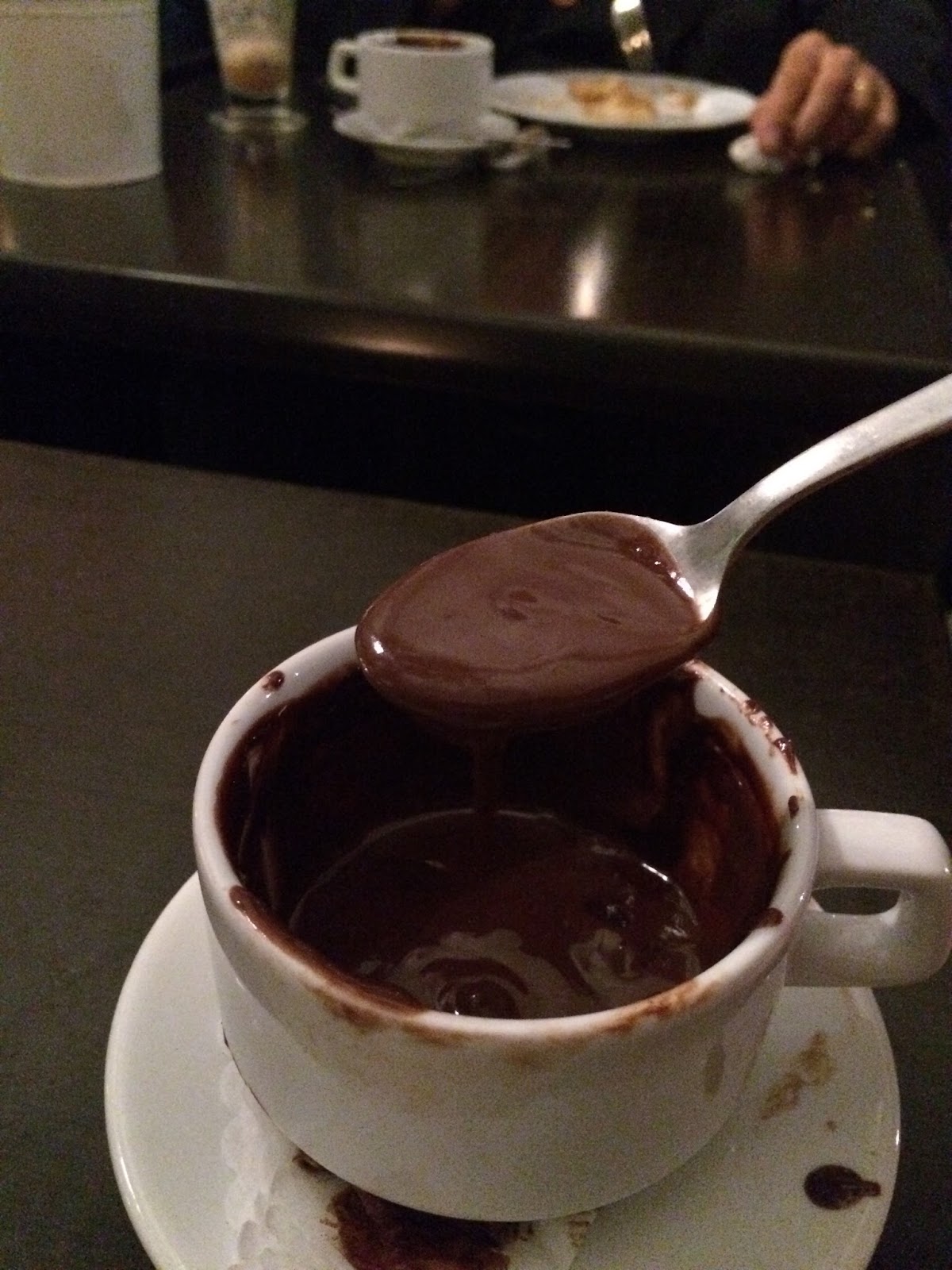
She ordered the hot chocolate, which was thicker than any I’ve ever seen and had to be eaten with a spoon. 
Happy birthday sweetie! 

A small notFit update

After three weeks of working out with CrossFit (4 times per week) I begrudgingly admit that I might be seeing some changes in my body. I say begrudgingly because I’ve been riding along on the assumption/hope that I would look the same whether I exercise or not. That’s every couch potato’s dream, but I guess my 40s have caught up with me.

I noticed when I went to reach for something that I actually had a visible bicep muscle. I poked it and it didn’t mush into my arm like it usually does. Interesting. And today I had to give Camille a piggyback ride because her new flips were giving her blisters, but I easily stood up under her extra weight because it was much less than the squats I had been doing this morning. I actually felt stronger. 

Another sign was when I got dressed for church on Friday morning I tried on a skirt that frustrated me the last time I wore it because my stomach was lipping over the waistband in a way that it didn’t use to, but this past weekend it looked as it did when I bought it. As many different times as I adjusted the waistband up and down, I couldn’t get it to pooch out in the same way as it did a few weeks ago. Coincidence? Maybe.

I thought I must be imagining things until we went to the pool and the hole in my thigh that started this all had turned into a dimple. I sat every which way on the lounge chair to make sure it wasn’t wishful thinking. It’s still there (actually 3 of them on the right and 2 on the left), but instead of reaching to China, they are just shallow dents. Carter didn’t seem that impressed when I tried to point out to him that my hole was gone. He brushed me off and went back to swimming.

I’m still dreading working out every day, but by doing it as soon as I wake up, it gives me less time to think about it and come up with excuses as to why I shouldn’t/can’t. I pretty much roll out of bed (after the 3rd alarm), throw on my clothes, make a coffee to drink in the car and am out the door in under 10 minutes. And today wasn’t as terrible as usual, so I actually had enough energy to make dinner. Or maybe that’s just what getting in shape feels like . . .

In the ghetto

Happy 5th Birthday Camille! Let’s spend it walking around the Jewish ghetto and feeling sad for all the horrible things that were done to people as part of WWII/the Holocaust. We were trying to schedule this part of our trip around the weather and it turned out that her birthday was going to be good day for walking around outside, so that’s what we did. She already thinks of the trip to Poland and Germany as her “birthday trip” and has put in her request for next year’s birthday trip to be to “Atlantis and Crete.” She has no concept that a normal birthday stateside might just be a trip to Chuck E Cheese and a few extra tokens. She’s in for a rude awakening someday . . .

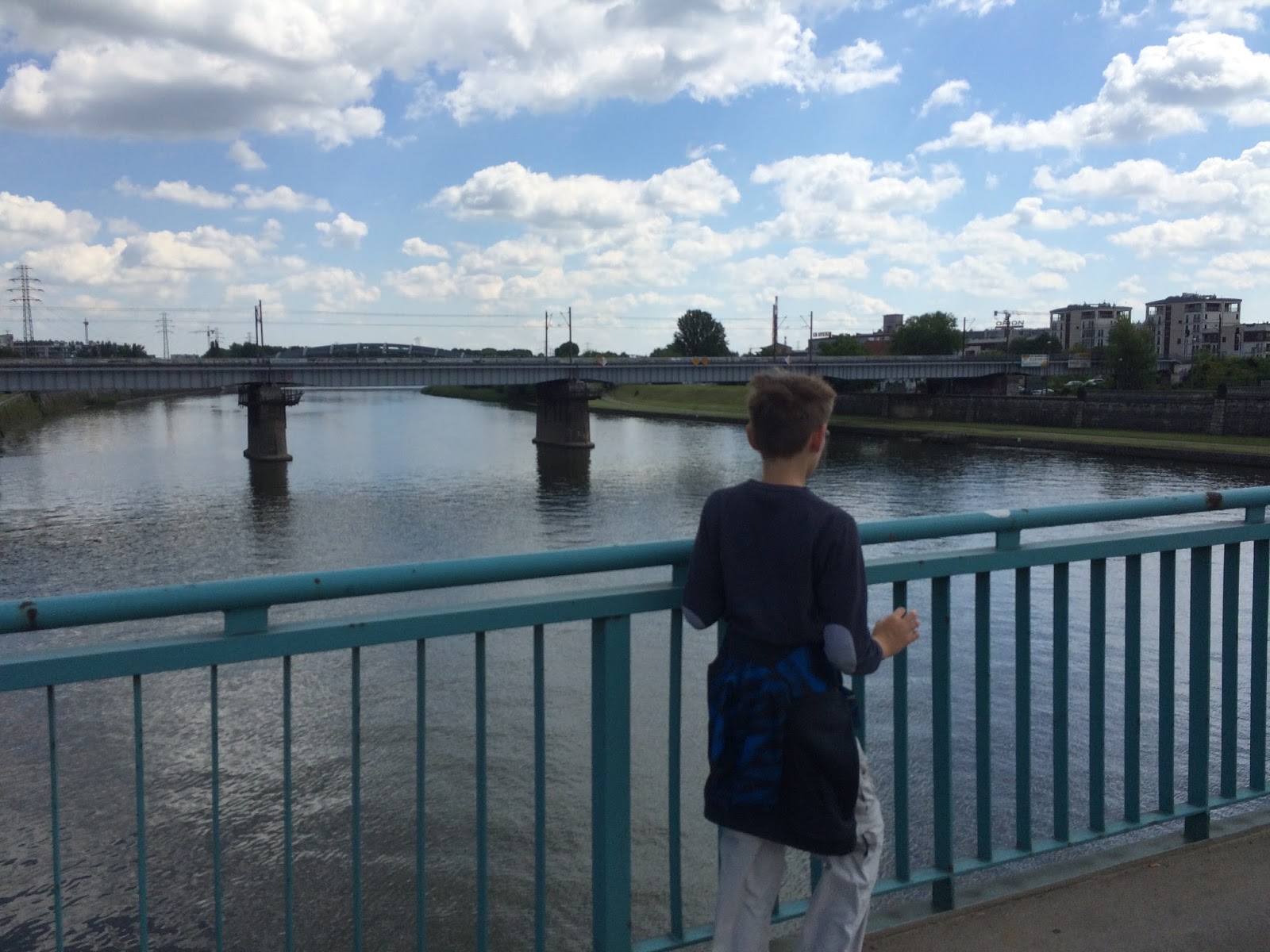
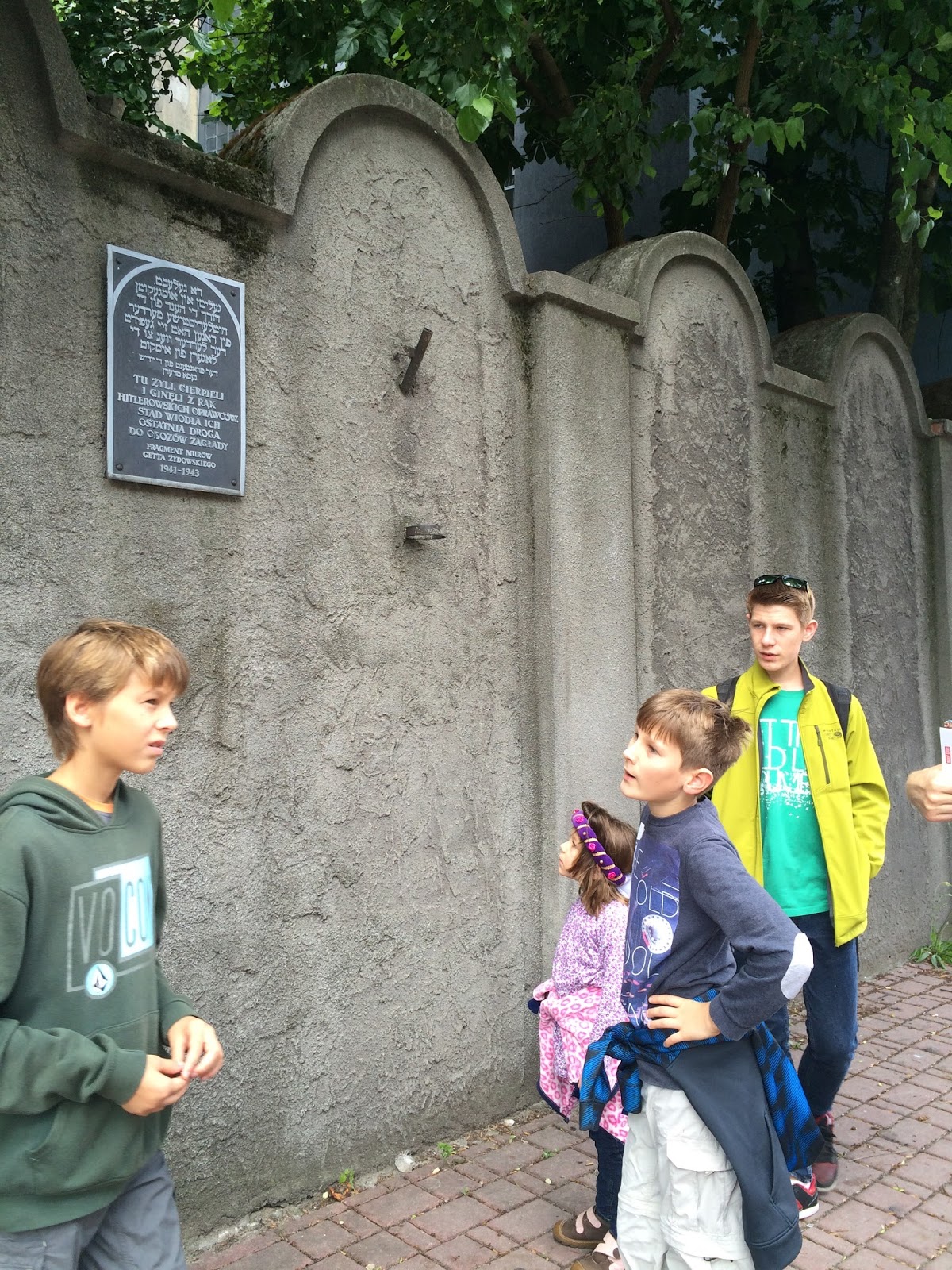
Krakow is a perfect walking city so we set out in the morning to walk through the old town square and headed south over the river to the Jewish Ghetto. Before the German invasion there was a Jewish area of Krakow, but the Germans moved everyone out of the city to the other side of the river and packed them all in a several block area that they walled off. 

A remaining portion of the wall. Before our trip I made the kids read several books about the Jewish experience during WWII. I read The Hiding Place aloud to them, which covered Jews in hiding, the underground resistance, and concentration camps. They also read The Boy on the Wooden Box, a book written by a survivor who worked in Shindler’s Factory when he was only 12. He lived in the ghetto in Krakow with his family and would walk to the factory each morning (as we would do on this day). The final book that I read is I Have Lived A Thousand Years by a girl who was 13 years old when the Germans took over her village in Hungary and she was eventually transferred to Aushwitz, the Plaszgow labor camp (located 2 tram stops away from the ghetto), and Dachau, before finally being liberated by the Americans. (I recommend all 3 books.) 
Reading memoirs of individual experiences made everything we saw more personal. I felt like we knew the people we read about so seeing the places where they lived and worked and survived became, “This is where Leon would have gone through the gates,” or “this is where Corrie and her sister slept.”

A study in contrasts. 

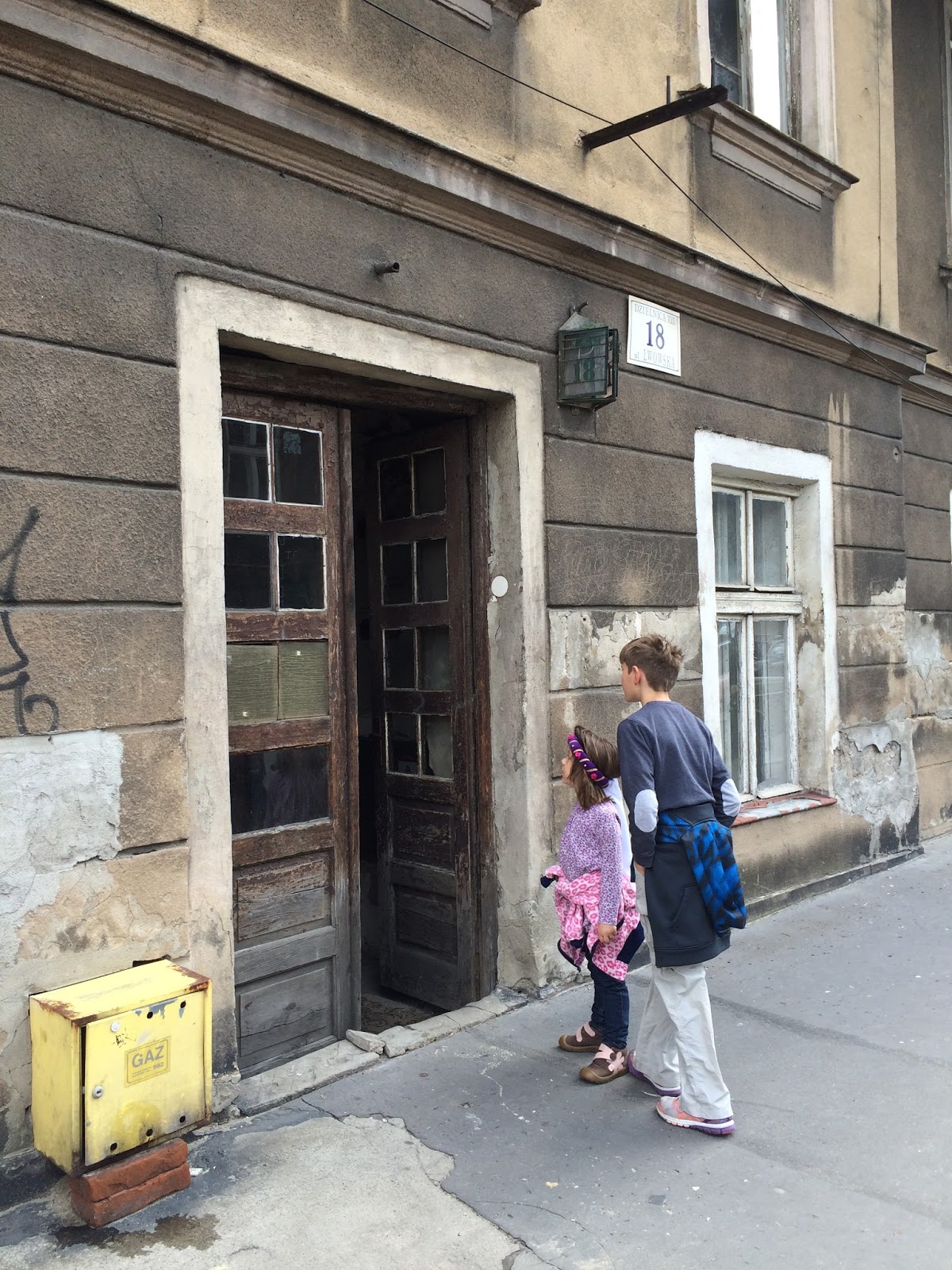
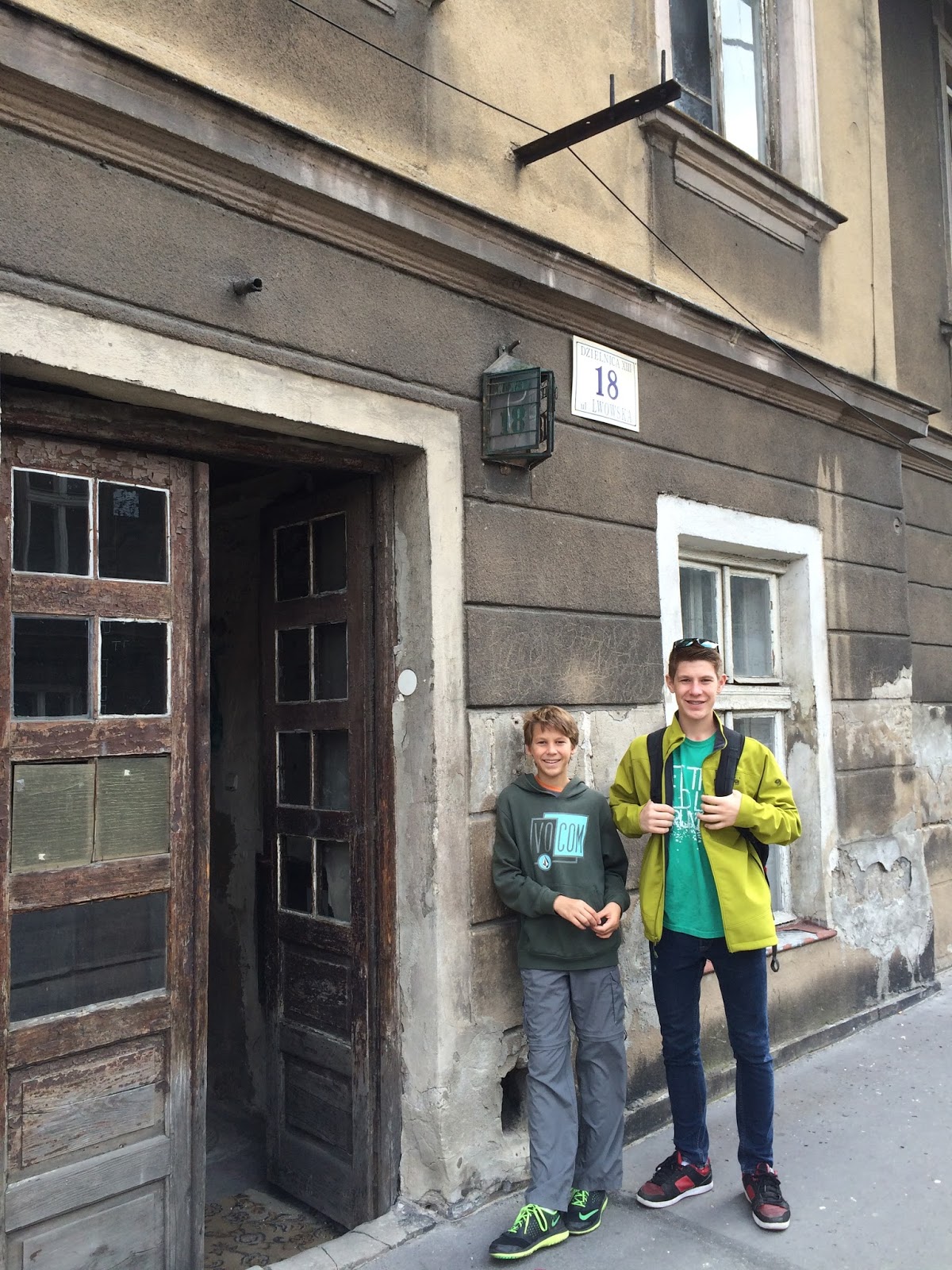
We found Leon’s house — 1/2 a block down the street from the wall. (The author of The Boy on the Wooden Box.)

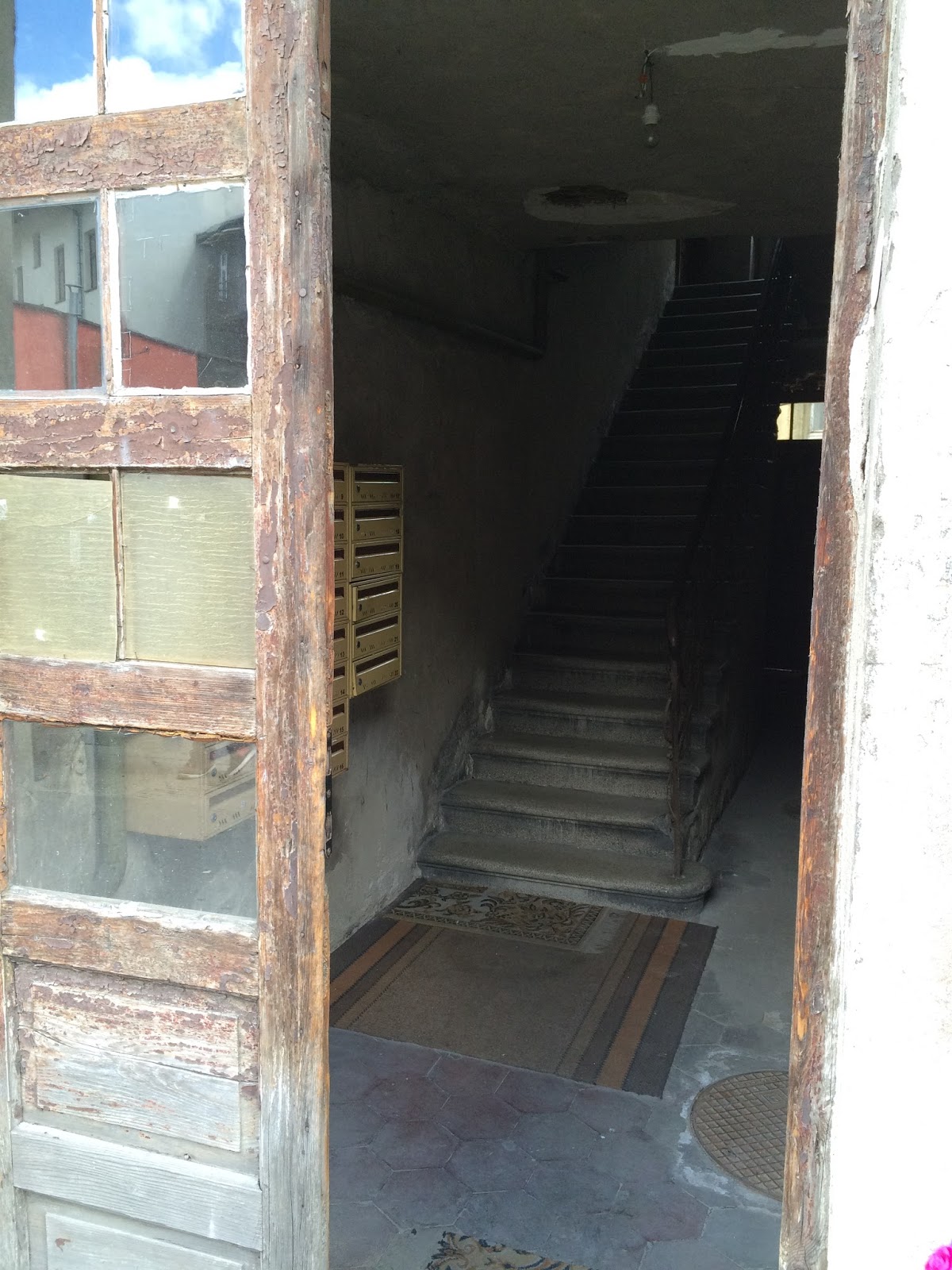
Leon and his family lived on the 2nd floor — I wonder who lives here now and if they know the history of these apartments?

Caleb didn’t want to read the book because he kept hearing the title as “The Boy IN the Wooden Box.” Our reading of The Hiding Place traumatized him a bit. Carter really absorbed all the details of the book and kept telling me things like, “Leon’s mom and sister were sent to Auschwitz, but then Schindler went and rescued them.” My non-reader actually got something out of a book! 

Heroes Square. Empty chairs representing lives lost. This is the square where they would round Jews up to be deported to various concentration/extermination/labor camps. I warned the kids that they better not sit down in any of the chairs!
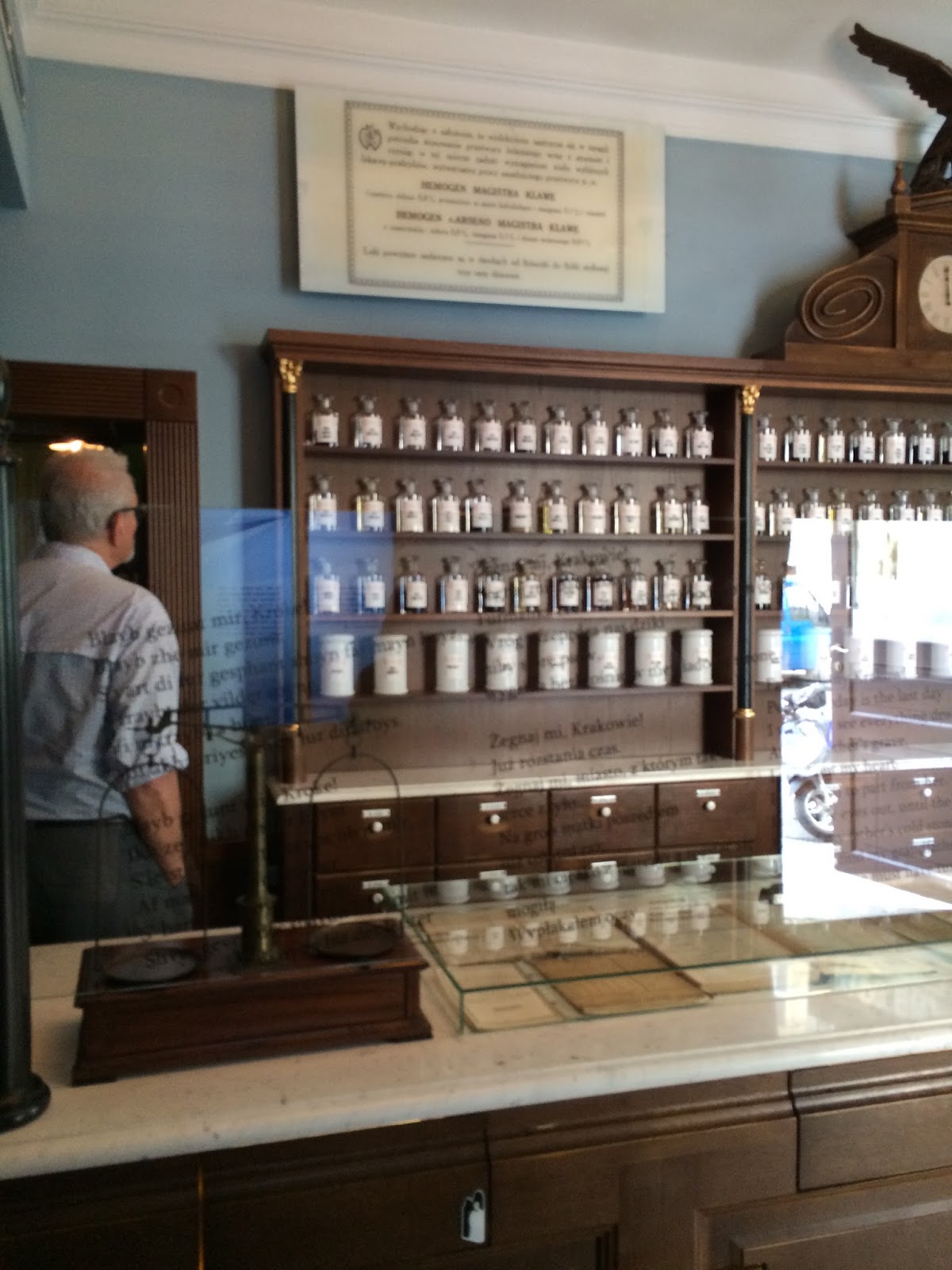
Right across the street from the square is the Pharmacy Under the Eagle. At the time that the area was turned into the Jewish Ghetto the families that lived in the area were forced to move out. The owner of the pharmacy was the only Christian to remain. His pharmacy became the headquarters of the resistance where people would go for news, forged papers, and lifesaving treatments (including hair dye so the elderly could appear younger and escape being culled/executed). 
Today the building is a museum that honors the work that they did and depicts what life was like for those who lived in the ghetto through photographs, first person narrative audio recordings, and video.

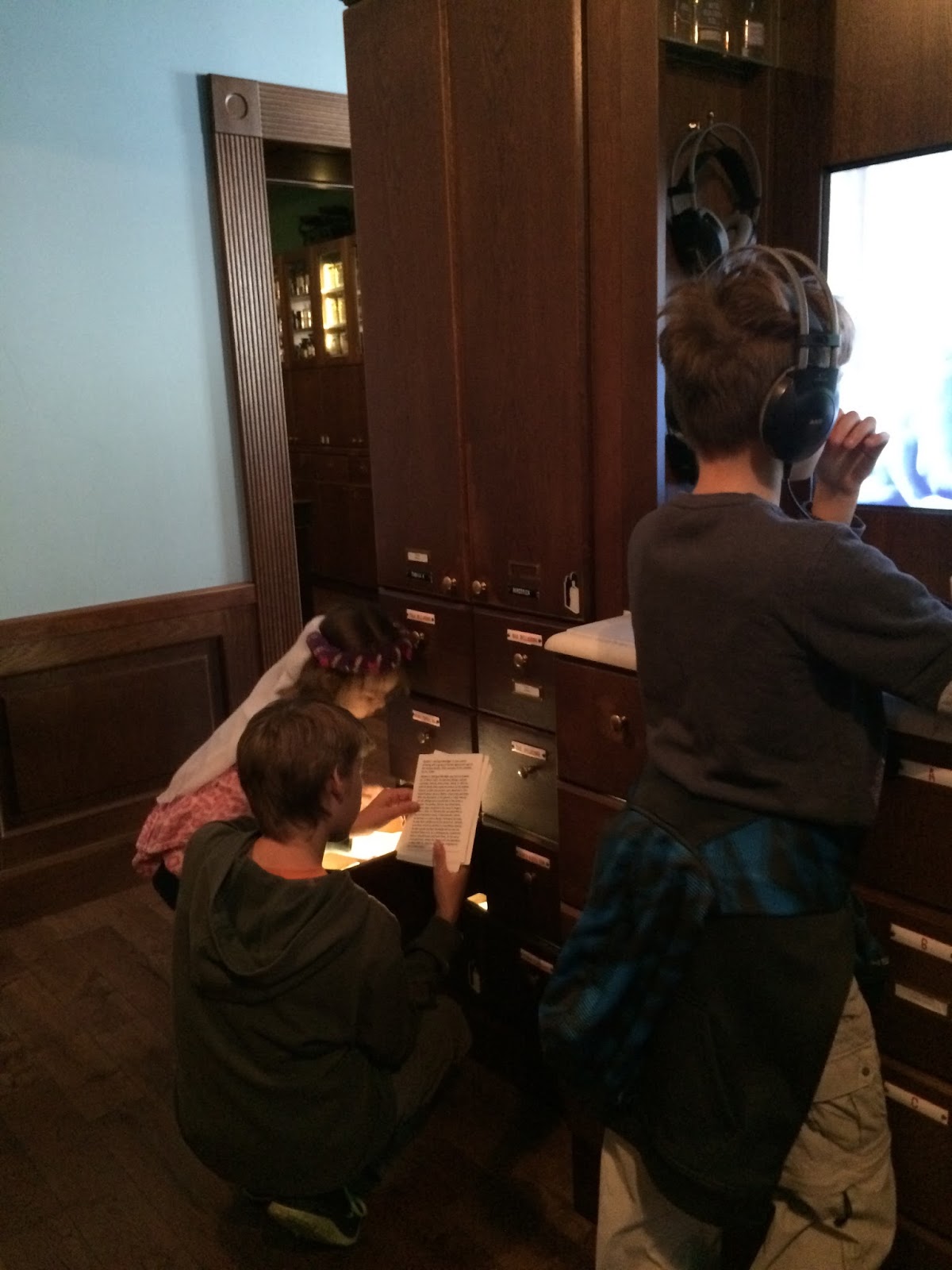
It has a great selection of hands-on materials. The drawers all open to reveal photographs, diary entries, and other replicas of prescriptions, issues of the underground newspaper, or logbooks of confiscated possessions or lists of people. 

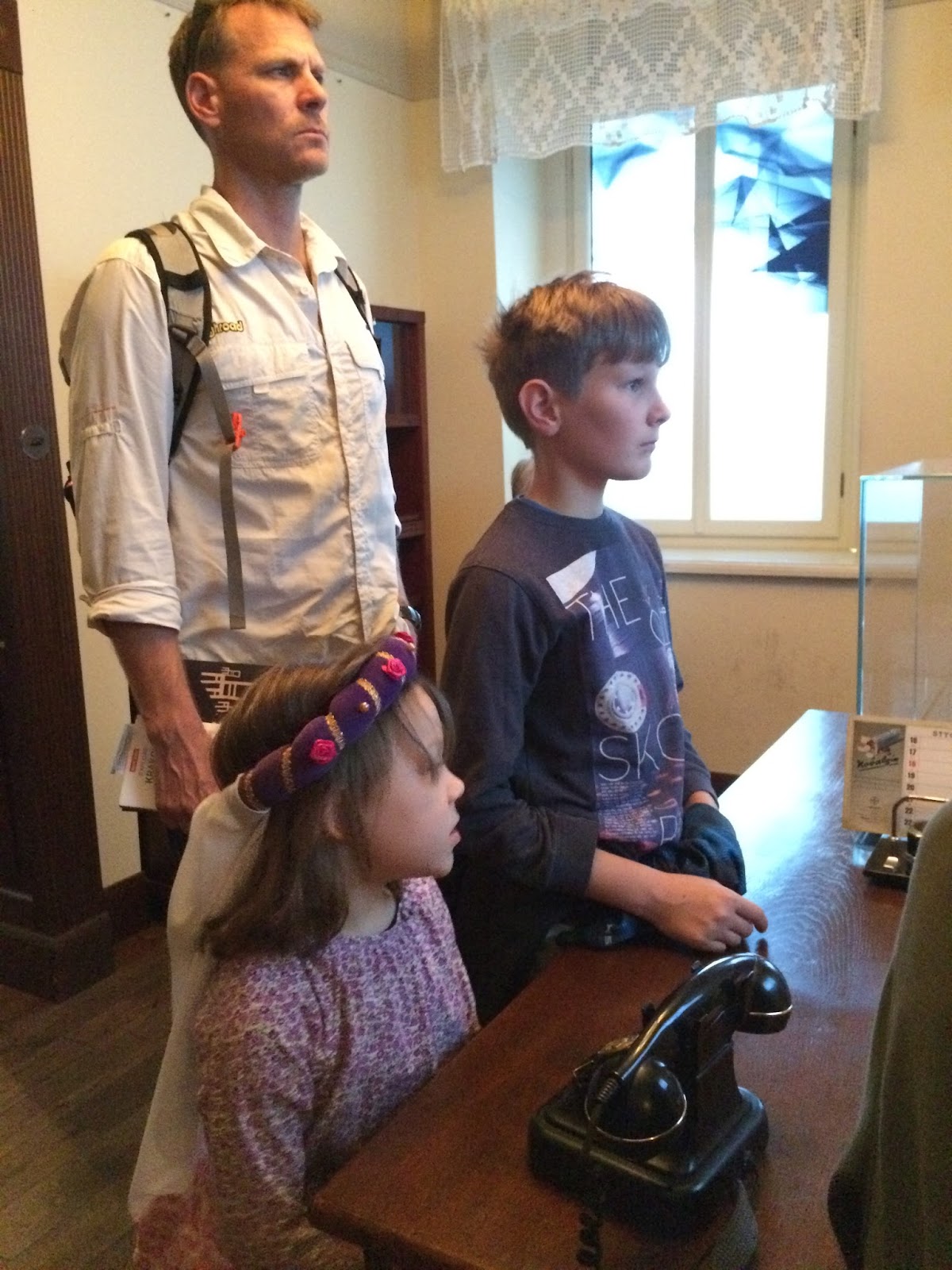
Inside the pharmacist’s office. They had a short movie clip of him standing in front of his pharmacy, being interviewed after one of the deportations, upset by what he saw. 
The various old fashioned telephones offer recordings from different survivors and witnesses. One that I listened to talked about a young man who came into the pharmacy, shook up because the soldiers forced him and some of the other Jews to hang poles. It was only later that I realized what he meant was they were hanging Poles, or Polish people. That put a different spin on things!

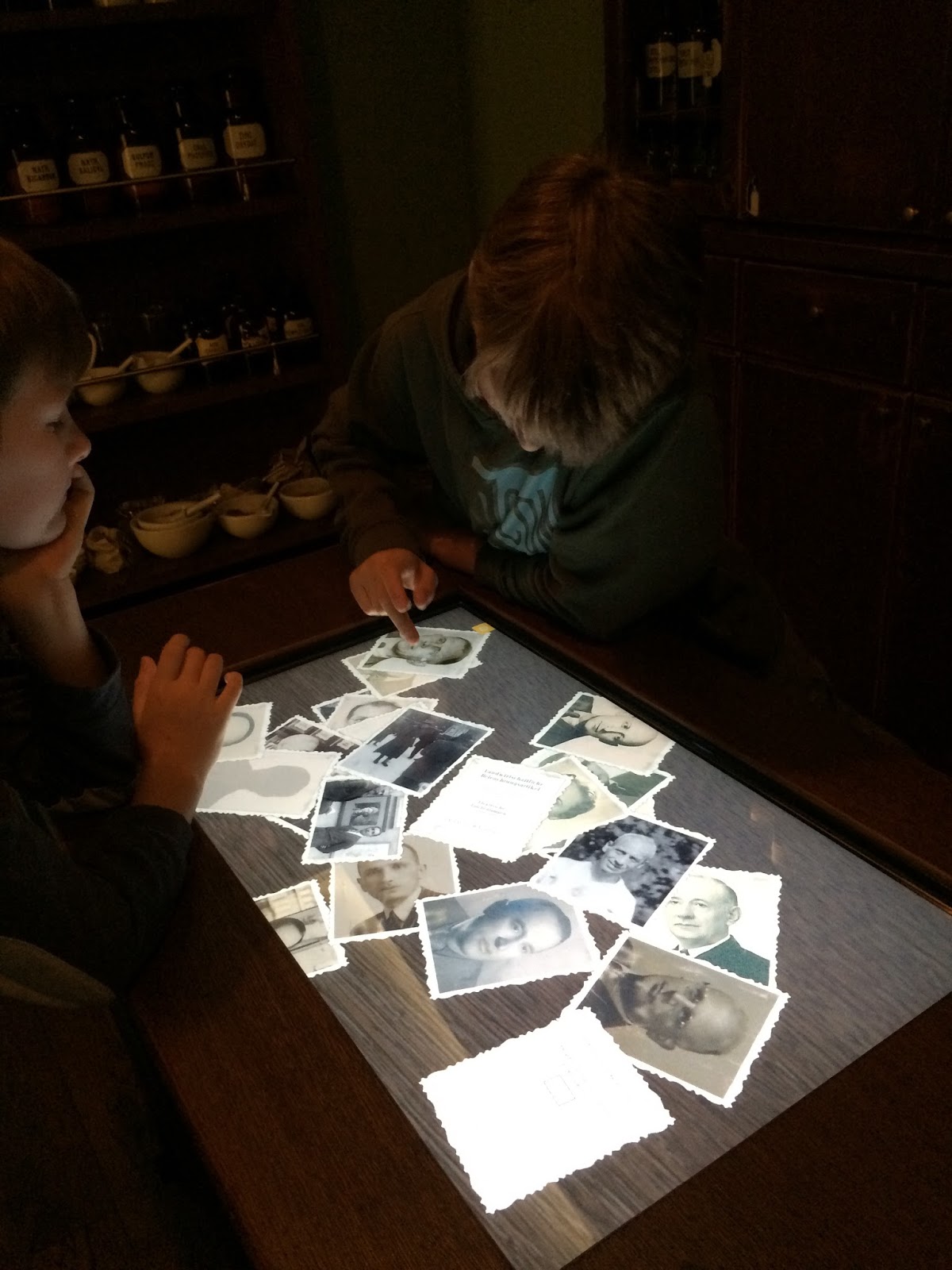
Interactive photographs. Slide, spin, enlarge and click on them and information would be revealed about each person. Some were Jews, some were Nazis, some were heroes and some were villains. Caleb kept asking, “Is this one a good guy or a bad guy (or woman)?” Sometimes it was hard to say. There are a lot of shades of gray as people are struggling to survive. One might share the last of his food, but then turn around and rat someone else out to the SS. 

It looks peaceful, but they spent much of the time fighting over who was going to control the screen since it would respond to only one touch at a time. I had to explain that it was disgusting to be fighting over who got to pick the person to read about when most of these innocent individuals had died horrible deaths.
After about an hour or so, we had covered most of the information on display. It’s a small place, with a fascinating history and I love how the information was presented in bits and pieces throughout the place. All the individual stories were more memorable to me than a big picture historical summary would have been. 
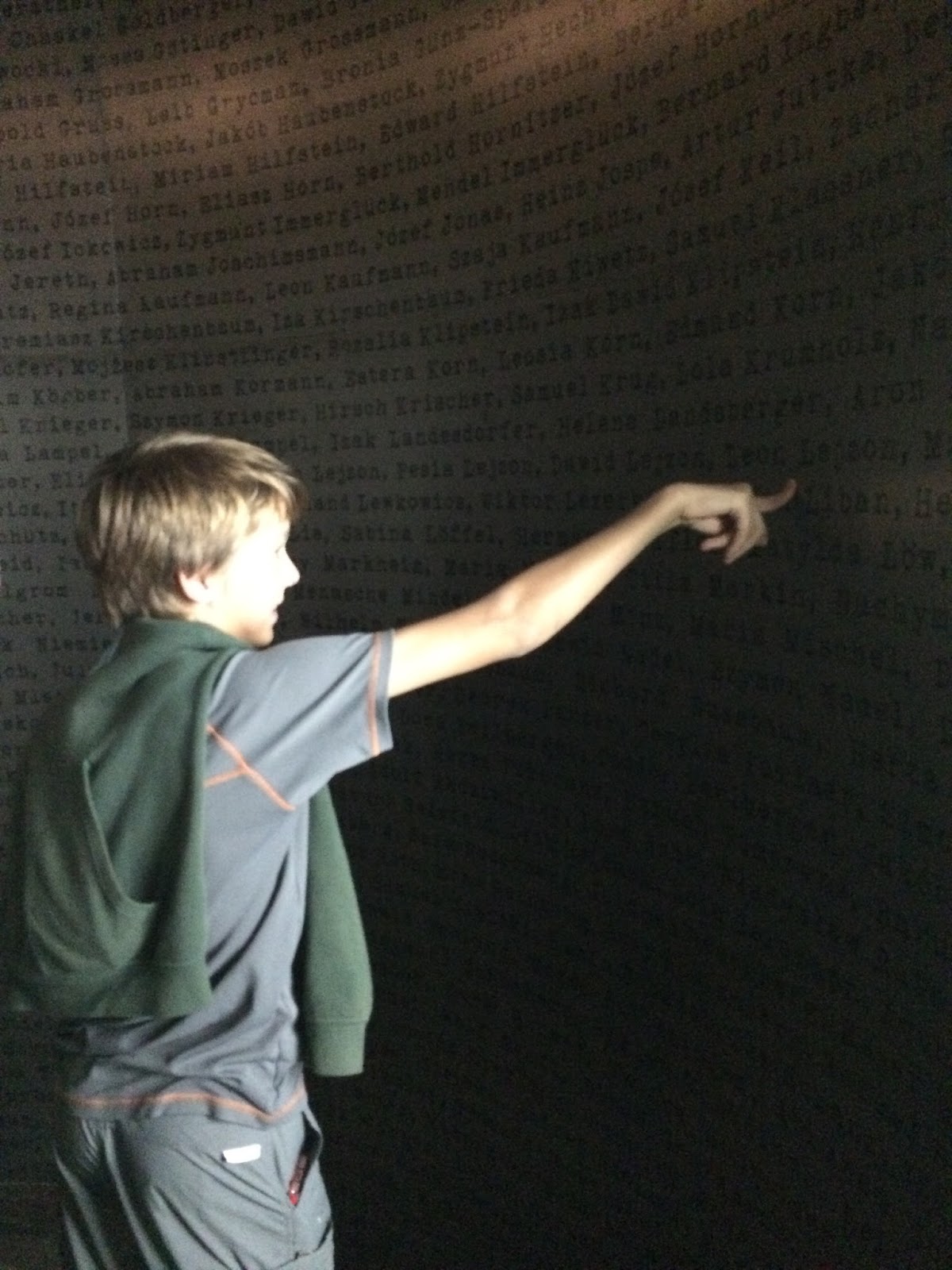
After lunch we walked over to Schindler’s Factory. I didn’t take any photos here, aside from this one, because it was a bit heavy. A majority of the museum is focused on Krakow in World War II, with a small portion focused on Schindler. The photo above was taken in Schindler’s office, where there’s a replica of “his list” on a wall. Carter set out to find Leon’s name (The Boy on the Wooden Box) and found his entire family. 
My other favorite part of this museum was a 30 minute movie that they showed of interviews with those who worked in the factory and survived the Holocaust as a result. In one portion they talked to one of the secretaries that told a story about the day that he took a group of employees out to the salt mines. (The mines that we had been to the day before!) It was a good day and a nice time and then he gave them each an envelope and asked them not to open it yet, but that he hoped that someday they would understand. It turned out that each of them had been fired. They were angry and upset and the secretary couldn’t understand why this had happened. 
The following day, the Secret Police showed up at the factory with a list of names and as the secretary read down the list, she realized it was the exact same list as those who had been let go the day before. She was able to tell the SS that unfortunately those individuals had all been terminated and she had no knowledge of their whereabouts. 
It was a heavy afternoon, but an important experience. I’m glad that my kids got to see these things and talk about them and hear the stories. 
A bunny catching the breeze.
After we left Schindler’s Factory, we walked back over the river and to the old Jewish Quarter, where there was a thriving Jewish community before the Germans invaded. Currently there are only about 200 Jews left living there. 
We visited a few synagogues

And saw some of the old posters encouraging Jews to come to Palestine after the war was over. 

My favorite photo of the day: Josh and his mini-Me trying to decipher the Arabic script in the graffiti in the Jewish Quarter.

A unique birthday for sure!